
Low Water Pressure Whole House? How to Trace the Cause
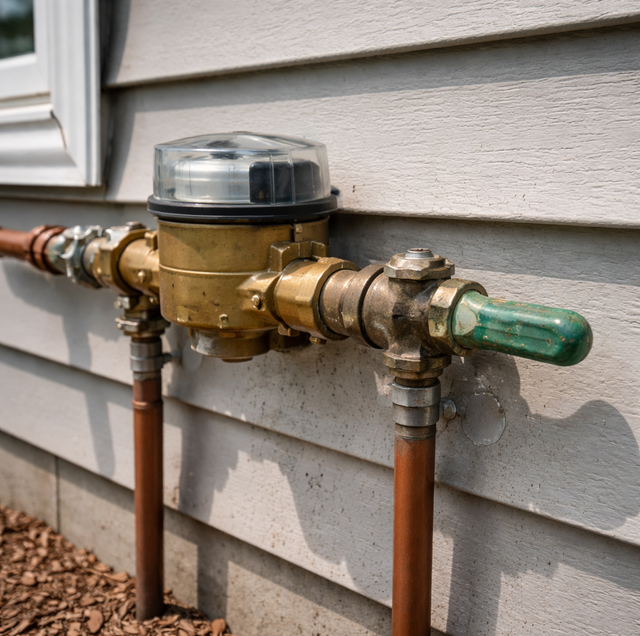
Quick Answer: Whole-house low pressure usually traces to a partly closed main or meter valve, a failing pressure-reducing valve (PRV), mineral scale narrowing old pipes, a hidden leak, a clogged whole-house filter or softener, or a municipal or well-side supply problem. Test with a gauge on a hose bib (40 to 60 psi is normal), and narrow it to one source before fixing.
When every faucet in the house trickles instead of flows, the problem is rarely the faucet. Whole-house low pressure is a supply-side signal: something between the water main and your fixtures is choking the flow before it ever reaches a tap. The good news is that the same fact that makes it frustrating also makes it solvable. Because one shared cause is starving every fixture, you can trace it back to a single point instead of chasing problems room by room.
The work is mostly detective work. You narrow down where the pressure drops off, then match that location to a short list of likely culprits. This guide walks the water's path from the meter inward, so you can figure out whether it is a quick homeowner fix or a job for a licensed plumber.
One Fixture Or The Whole House
Before you touch anything, sort the problem into one of two buckets, because they point in opposite directions.
If only one faucet or showerhead is weak, the cause is local: a clogged aerator, a gunked-up cartridge, a kinked supply line, or a partly closed angle stop under that sink. The rest of the house is fine, so the supply is fine.
If the weak flow shows up at nearly every fixture, the cause sits upstream of all of them, on the main line that feeds the house. That is the case this guide addresses. A fast way to confirm it: run the kitchen sink, a bathroom sink, and a tub, one at a time. If all three are weak, you are looking at a whole-house issue.
One more split worth making early. Check hot versus cold. If only the hot side is weak everywhere, suspect the water heater or its shutoff valve, or scale buildup in the heater and its nipples. If both hot and cold are weak, the problem is on the main supply before the water ever splits toward the heater.
Low Pressure Versus Low Flow
These two get confused constantly, and the difference changes what you look for.
Pressure is the force pushing the water, measured in psi. Flow (or volume) is how much water actually moves, measured in gallons per minute. You can have strong pressure but poor flow if a pipe is narrowed by scale, and you can have weak pressure but adequate flow if a regulator is set low. A pressure gauge tells you the first number. Timing how long it takes to fill a one-gallon container tells you the second. When both are low across the house, a supply restriction or a regulator problem is the usual answer.
Tracing It From The Meter Inward
Follow the water in the order it travels, and you will not skip a suspect.
The main shutoff and meter valve: The simplest cause is a valve that is not fully open. After any plumbing work, a shutoff sometimes gets left partly closed, which throttles the whole house. Find your main shutoff (often where the line enters the house, near the water heater, or in a garage) and confirm it is fully open. A gate-style valve should turn until it stops; a lever (ball) valve should sit fully parallel with the pipe. The meter-side valve at the street can also be partly closed after utility work.
The pressure-reducing valve (PRV): Most homes on city water have a PRV, a bell-shaped brass valve usually near where the main enters, that knocks the street's high pressure down to a house-safe level. PRVs wear out. When the internal parts fail, or the spring weakens, they can drift, and a failing one often drops house pressure gradually over months. A PRV can also be set too low. Adjusting or replacing a PRV is a plumber's work, partly because setting it wrong in the other direction is dangerous.
Old galvanized pipe, scale, and corrosion: In older homes with galvanized steel supply lines, the inside of the pipe slowly fills with rust and mineral scale, shrinking the usable diameter like plaque in an artery. The flow keeps falling year after year until a half-inch pipe passes water like a straw. This is gradual and permanent; the fix is repiping the affected runs, not cleaning them out.
A whole-house filter or water softener: If you have a sediment filter, carbon filter, or softener plumbed into the main, a clogged cartridge or a softener stuck mid-cycle will strangle the whole house. This is one of the more common surprises, because people forget the filter is there. Many filter housings have a bypass; switching to bypass tells you immediately whether the filter is the choke point.
A hidden leak: A leak on the supply line, underground or inside a wall, bleeds pressure before it reaches your fixtures. A leak severe enough to drop whole-house pressure will usually show other signs: a spike in the water bill, a wet or unusually green patch in the yard, a running-water sound with everything off, or a damp spot on a wall or slab. This one is not just an inconvenience. Water finding its way into framing or under a slab can cause structural damage and mold, so a sudden pressure drop paired with any wet spot deserves fast attention.
The municipal or shared supply: Sometimes the house is fine, and the street is not. A water-main break, hydrant flushing, utility work, or high neighborhood demand at peak hours can all lower what reaches your meter. If your neighbors notice the same dip at the same times, the cause is on the utility's side, not yours.
On a well: the pressure tank and pump: Homes on a private well do not have a PRV setup; they have a pump and a pressure tank that cycle between a cut-in and cut-out pressure. A waterlogged tank (one that has lost its air charge), a failing pressure switch, or a tiring pump will show up as weak or wildly fluctuating pressure everywhere. That is a well-system diagnosis, distinct from anything on a city line.
Testing It Yourself With A Gauge
A screw-on water pressure gauge costs little and turns guessing into measuring.
Thread it onto an outside hose bib, ideally the one closest to where the main enters, and open the valve fully with no other water running. A healthy reading sits roughly between 40 and 60 psi. Below about 40 psi, the whole house will feel weak; that is your confirmation the pressure itself is low.
To find out whether the problem is yours or the street's, compare readings. Test a hose bib on the street side of any filter or softener, then one downstream of it; a big drop across the unit points at the filter. If you can test near the meter and the pressure is already low there, the restriction is upstream of your house.
Quick Checks Before You Call
A handful of things are safe and worth trying first.
Open the main all the way: Confirm both the house shutoff and, if accessible, the meter valve are fully open.
Clean aerators and showerhead screens: Even a whole-house feel can be exaggerated by scaled-up aerators at every tap. Unscrew them, soak them in vinegar to dissolve mineral deposits, and reinstall.
Bypass or change the filter: If you have a whole-house filter, put it in bypass or swap a clogged cartridge and see if pressure returns.
Check the softener: If a softener is stuck in regeneration or bypass, resetting it may restore normal flow.
Look and listen for a leak: Shut every fixture, then watch the meter's flow indicator. If it keeps moving, water is going somewhere it should not.
When It Is A Plumber's Job
Some repairs sit past the DIY line, either because they need specialized tools or because getting them wrong is hazardous.
A PRV that needs adjusting or replacing is one. It is tempting to crank a PRV up to force more pressure, but running a house much above 80 psi stresses supply lines, fixtures, and the water heater, and can shorten their life or cause a failure. A PRV should be set to a safe target by someone who can verify it with a gauge.
Scale-narrowed galvanized pipe calls for repiping the affected runs, which is a full plumbing job. A hidden supply leak needs to be located and repaired before it damages the structure. A failing pressure regulator, a well pump or tank problem, and anything requiring the main to be cut all belong to a licensed plumber. Knowing where your main shutoff is, and that it works, is the one piece of prep that pays off in every one of these situations.
Frequently Asked Questions
When cold runs strong but hot is weak everywhere, the split happens at the water heater. Sediment settling at the bottom of the tank, scale in the heat-trap nipples, or a partly closed valve on the heater's cold inlet all restrict the hot side alone. Flushing the tank on a maintenance schedule clears sediment before it builds up enough to choke flow.
Anything sustained above 80 psi is considered too high for residential plumbing and can void some fixture and water-heater warranties. Signs include banging pipes, running toilets, dripping relief valves, and appliance hoses that fail early. A gauge left on a hose bib overnight catches pressure spikes that only happen when city demand drops after midnight.
A failed expansion tank does not usually lower steady pressure, but a waterlogged one can let thermal expansion spike pressure sharply each time the heater fires, then settle. Tapping the tank tells you: the top half should sound hollow and the bottom solid. An all-solid sound means it has lost its air charge and needs replacing.
Gradual loss over months usually means scale buildup or a slowly failing PRV. A sudden overnight drop points to a specific event: a valve knocked partly shut, a filter cartridge that finally clogged, a PRV that failed outright, a pipe that broke, or a utility issue on the street. The timeline itself is a clue worth noting before you call.
No. Pressure and flow are different measurements. A gauge can read a healthy 50 psi at a hose bib while a scaled-up interior pipe still throttles the volume reaching a distant bathroom. If pressure tests fine but flow feels weak far from the meter, suspect a narrowed pipe on that specific run rather than a whole-house pressure fault.
Almost never. A dripping faucet wastes water but does not measurably lower pressure at other fixtures. Whole-house pressure loss comes from restrictions or leaks on the main supply, not from a slow drip at one tap. Chasing a single drip when every fixture is weak wastes time better spent testing the main with a gauge.
Get your whole-house pressure tested and traced to the source — before a hidden leak turns into damage. Flow Tech Plumbing serves Peoria, Surprise, and Glendale. ROC #347159. Call (623) 267-2703.
