
White Spots on Dishes? The Hard-Water Fix That Sticks
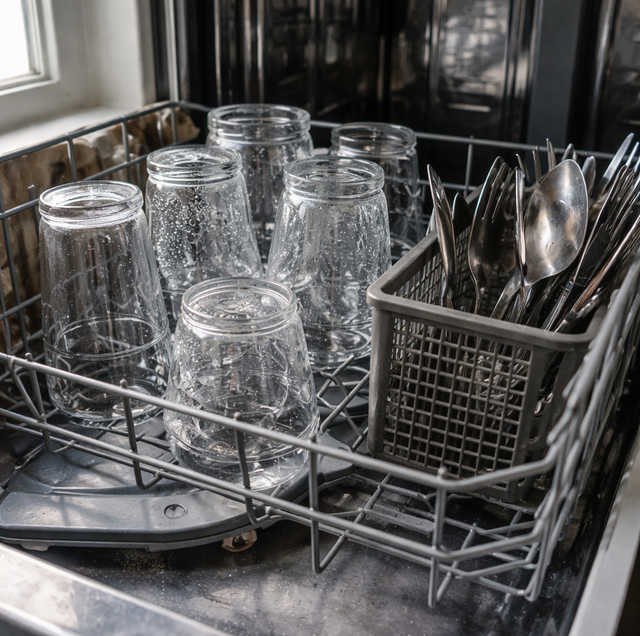
You pull a glass out of the dishwasher, hold it up, and there it is: a hazy film or a scatter of white flecks that no amount of towel-drying seems to prevent. Rinse it, wipe it, run it again, and the spots come right back. It looks like a soap problem, so most people reach for more detergent, which usually makes things worse.
The spots almost never start with your soap. They start with your water, and specifically with what your water is carrying.
Quick Answer: White spots and cloudy film on dishes come from dissolved calcium and magnesium in hard water. As droplets dry on the glass, the water evaporates and leaves the minerals behind as a visible residue. A working rinse aid, hot enough water, the right detergent dose, and clear spray arms all reduce spotting. A whole-house water softener removes the minerals at the source and stops it for every fixture, not just the dishwasher.
What Actually Leaves the Spots
Tap water is rarely just water. As it moves through rock and soil, it picks up dissolved calcium and magnesium, the two minerals that make water "hard." You cannot see them because they are dissolved, the way sugar disappears into iced tea. They stay invisible right up until the water dries.
When a droplet sits on a glass and evaporates, the water leaves, but the minerals cannot. They have nowhere to go, so they stay put on the surface as a tiny crust. One droplet becomes one flat white ring. Thousands of microscopic droplets across the whole glass become an even, cloudy haze. That is the entire mechanism: dissolved minerals in, water out, minerals left on the surface.
This is why the spots concentrate on glasses and flatware more than on plates. Smooth, vertical, clear surfaces show every fleck, and they hold droplets that air-dry in place instead of running off. A rough ceramic plate hides the same residue.
Hardness is measured in grains per gallon. Water under about 3 grains per gallon rarely spots. Above roughly 7 grains, spotting becomes stubborn and predictable. A lot of municipal and well water sits well above that line, which is why so many dishwashers fight the same haze regardless of brand or age.
Spots You Can Remove Versus Etching You Cannot
Before you chase a fix, settle one question: is the cloudiness sitting on top of the glass, or is it damage in the glass? The two look similar at a glance and have opposite causes.
Dab a cloudy spot with plain white vinegar or lemon juice, wait about a minute, and wipe. If the haze lifts, it is removable mineral film; if it stays, the glass is etched, and no cleaner will bring it back.
Etching (permanent): Etching is microscopic pitting in the glass itself, and no cleaner brings it back. It reads as a rainbow or oil-slick sheen in the light, and it stays the same after the vinegar test. Etching comes from the opposite of a hard-water problem: water that is too soft combined with too much detergent and very hot, long cycles. In that mix, the wash water goes hunting for minerals to grab, and it slowly leaches them out of the glass surface.
That second point catches people off guard, especially right after installing a softener. Softened water plus a heavy detergent scoop plus a hot cycle can etch glassware in a matter of weeks. The fix is to cut the detergent dose sharply once you soften the water, because soft water needs far less soap to do the same work.
The Rinse Aid Job Most People Skip
Detergent's job is to lift food and grease during the wash. Rinse aid does something completely different, and it is the single most overlooked spot fighter in the machine.
Rinse aid is a surfactant. It lowers the surface tension of the water so droplets cannot bead up and cling. Instead of sitting on the glass as round beads that dry into rings, the water flattens into a thin sheet and slides off before it can dry. Fewer standing droplets means fewer places for minerals to strand themselves.
Two habits keep it working:
- Keep the dispenser filled: The reservoir empties faster than people expect, and a lot of spotting complaints trace back to an empty well nobody checked.
- Turn the dose up in hard water: Most dispensers have an adjustable setting, often 1 through 6. In hard water, run it near the top of the range. If glasses still spot at the highest setting, the water is the problem, not the rinse aid.
Water Temperature and Detergent, the Two Dials You Control
Two everyday variables push spotting up or down, and both are free to adjust.
Temperature: Dishwashers rely on hot water to dissolve detergent fully and to flash-dry dishes at the end of the cycle. Most run best when incoming water is around 120 degrees. Cool water leaves detergent partly undissolved and lets droplets linger and air-dry, which strands more minerals. A simple check: run the kitchen faucet hot for a moment before starting the dishwasher so the machine draws hot water from the first fill instead of clearing a slug of cold out of the pipe.
Detergent type and dose: In hard water, gel detergents tend to underperform because minerals blunt their cleaning agents. Powder or pod detergents with water-conditioning ingredients hold up better. Dose matters in both directions: too little leaves food and film, and too much leaves its own chalky residue that mimics hard-water spots. Match the dose to your water and your load size rather than filling the cup out of habit.
When the Machine Itself Is the Bottleneck
Sometimes the water chemistry is fine, and the hardware is the holdup. Two clogs cause spotting that no rinse aid can outrun.
Clogged spray arms: The spray arms are the spinning bars that jet water across the racks. Their little holes scale up with mineral deposits and clog with food debris, and once flow drops, some dishes get rinsed poorly and dry with residue. Pull the arms (most twist or unclip off by hand), and clear each hole with a toothpick or a straightened paperclip. Soaking them in white vinegar loosens mineral buildup inside the channels. This is safe homeowner maintenance with no tools required.
Clogged faucet aerators: The aerator is the small screen at the tip of your faucet. In hard water, it crusts over with the same mineral scale, which is a useful early warning that the rest of your plumbing is collecting deposits too. Unscrew it, soak it in vinegar, and scrub the screen. Clearing it does not fix dishwasher spots directly, but a scaled aerator is a sign worth reading.
The Cleanup and the Real Cure
If spots have already built up, plain white vinegar is the tool. Its mild acid dissolves the mineral crust without scratching glass.
- For loose items: soak spotted glasses in a mix of one part white vinegar to three parts warm water for fifteen to thirty minutes, then rinse.
- For the whole machine: stand a cup of white vinegar upright on the top rack and run a hot cycle with no detergent and no dishes. This clears scale from the interior, the spray arms, and the lines.
Cleaning treats what is already there. It does not stop the next load from spotting, because the minerals arrive fresh with every fill. That is the difference between managing spots and ending them.
Rinse aid versus a whole-house softener: A rinse aid manages the symptom at one appliance. It helps water sheet off so fewer minerals strand on the glass, but the minerals are still in every drop. A whole-house water softener attacks the cause. It runs incoming water through resin beads that swap the calcium and magnesium for sodium, so the water leaving your pipes is soft before it reaches any fixture. Soft water leaves no mineral residue to dry on glass, which is why spots vanish from dishes, and scale stops forming on faucets, showerheads, and inside the water heater.
A softener install ties into your home's main water line, so it is a job for a licensed plumber, not a weekend project. Clearing spray arms and aerators, by contrast, is safe to handle yourself anytime.
When Spots Are a Warning About Your Pipes
Chalky dishes are the visible edge of something happening out of sight. The same minerals depositing on your glasses are depositing inside your plumbing and appliances, where you cannot wipe them off.
Over years, scale narrows the inside of pipes, coats heating elements, and collects at the bottom of the water heater tank as a hard crust. That buildup means slower hot water, higher energy bills as the heater works around its own insulation of scale, and a shorter life for the tank. White crust on faucets, a filmy ring in the toilet tank, and a water heater that pops or rumbles are all the same mineral story showing up in different rooms.
Read the dishes as a gauge. Persistent spotting despite a full rinse aid dispenser, hot water, and a correct detergent dose usually means the water hardness has outrun what the dishwasher alone can offset. At that point, the fix has moved upstream of the kitchen.
Frequently Asked Questions
Many spot-fighting detergents include citric acid or sodium citrate, which grab minerals during the wash. In very hard water, those additives get overwhelmed, and the leftover mineral load plus the detergent's own salts can dry into a heavier film than a plain detergent would leave. Above about 10 grains per gallon, no detergent formula fully compensates without softer water feeding the machine.
Yes. Calcium and magnesium carbonate are the same minerals in a calcium supplement, and the trace amount on a dried glass is harmless to ingest. The concern is cosmetic and mechanical, not a health risk. It only becomes a real problem when the same scale builds inside a water heater or narrows a pipe, which affects performance rather than safety.
Yes, and in hard water you should. Some newer machines advertise that certain all-in-one pods make separate rinse aid optional, but that guidance assumes soft or moderate water. In hard water, keep the dedicated dispenser filled alongside the pod. The pod's built-in rinse agent is a fixed small amount, while the dispenser meters extra surfactant into the final rinse where it does the most good.
It can. Heated dry evaporates water fast at high heat, but the minerals still deposit, so a heated cycle without rinse aid often bakes the film on harder. Air-dry or fan-assisted dry, paired with a full rinse aid dispenser, usually leaves the fewest spots, because the rinse aid sheets the water off before any drying method starts. The drying setting matters less than whether droplets are allowed to bead.
No. Carbon pitcher and faucet filters improve taste and remove chlorine and some contaminants, but they do not remove dissolved calcium and magnesium, so the spotting minerals pass straight through. Only ion-exchange softening or reverse osmosis removes hardness. Reverse osmosis is point-of-use for drinking water, while a softener is the whole-house answer that reaches the dishwasher.
Listen and drain. A tank collecting scale often pops, crackles, or rumbles during a heating cycle as water bubbles up through the sediment layer. Draining a quart from the tank's bottom valve into a bucket tells the rest: cloudy water with gritty white or tan flakes confirms mineral buildup. Sediment that has hardened into a shell usually needs professional flushing, since a heavy layer can bury the drain valve and resist a simple rinse.
Book a hard-water assessment — get spot-free dishes and protect every appliance in the house. Flow Tech Plumbing serves Peoria and the Valley. ROC #347159. Call (623) 267-2703.
