
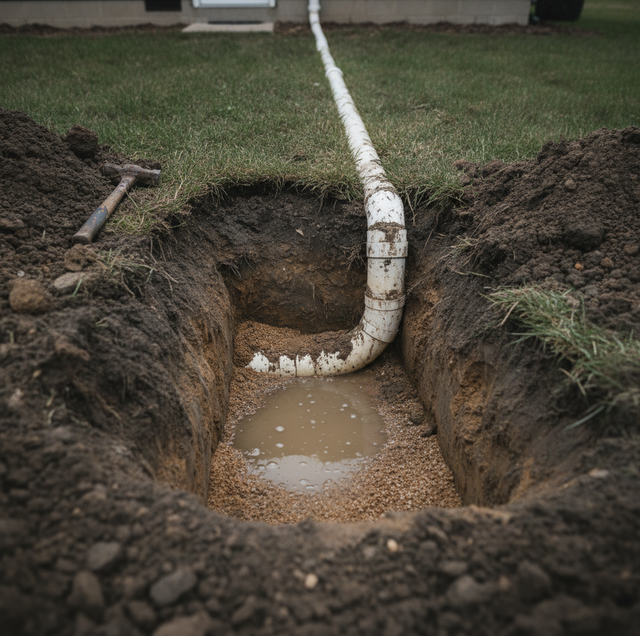
Quick Answer: A sewer line belly is a section of pipe that has sagged below the continuous downhill grade it was built on, forming a low spot where water and waste pool instead of flowing out. Solids settle in that dip, grease coats it, and the line clogs again and again. Most bellies come from the ground under the pipe shifting or settling after installation. Snaking clears the blockage but leaves the sag, so the clogs come back. The real fix is to re-grade or replace the sagged section and correct whatever made the soil move.
You've had the same drain back up three times this year. Each time a plumber snakes it, water runs fine for a few weeks, then it clogs in the exact same place. If that pattern sounds familiar, the pipe itself may be the problem, not the debris in it. A sewer line belly is one of the most common reasons a line clogs on repeat, and no amount of snaking will make it stop for good.
What a Sewer Line Belly Actually Is
A sewer line is supposed to run at a steady downhill slope, usually around a quarter inch of drop per foot, so gravity carries waste toward the main. A belly is a spot where the pipe has dropped below the intended grade and formed a dip. Instead of everything flowing straight through, water and waste hit the low point and pool there.
Think of it like a garden hose lying across an uneven lawn. Where the hose sags into a low spot, water sits in the loop instead of running through. A sewer belly does the same thing underground, except the standing water inside it never fully drains.
That pooling is what makes a belly so stubborn. Solids that would normally get flushed along settle out in the still water. Grease and soap film coat the bottom of the dip and harden. Toilet paper snags on the buildup. Over months, that low spot narrows until the line clogs, and because the dip is permanent, it clogs there again after every cleaning.
Why Sewer Lines Develop Bellies
A pipe doesn't sag on its own. Something under it or around it has to give way, and there are several usual suspects.
Poor bedding and compaction at installation — A sewer pipe is only as stable as the ground it rests on. When a line is laid, it's supposed to sit on a bed of compacted soil or gravel that supports it evenly along its length. If that bedding was loose, rocky, or never properly compacted, the soil settles unevenly over the following months and years. The pipe follows the soil down, and a low spot forms. This is one of the most common origins of a belly, and it often shows up within the first few years after a build or a repair.
Ground movement and settling soil — Even a well-installed line sits in soil that moves. Expansive clay swells when it takes on moisture and shrinks when it dries, and that cycle lifts and drops anything buried in it. Backfill disturbed during the original trenching remains looser than the undisturbed ground around it, so it continues to settle for years. In many areas, soils are heavy in expansive clay, and the seasonal wet-dry swing works on buried pipe year-round rather than in any one month. Over time, that constant flexing pulls a section of the line out of its original grade.
Erosion and leaks washing out support — Water is the quiet culprit behind a lot of bellies. If the pipe develops a small leak at a joint, or if groundwater and irrigation runoff track along the trench, the moving water carries away the fine soil packed under the pipe. Once that support erodes, the pipe has nothing holding the low section up, and it drops into the void. This is why a minor leak that seems harmless can turn into a sag over a few seasons.
Heavy loads pressing from above — Weight on the surface transfers down to the pipe. A driveway extension, a new patio slab, a shed, or vehicles repeatedly parking over the line all add loads that the original trench may not have been built to carry. That downward pressure can compress the bedding and push a section of pipe below grade, especially where the soil underneath was already loose.
Tree roots and disturbed soil — Roots rarely create a belly by themselves, but they contribute in two ways. As large roots grow and later die or are removed, they leave voids and disturb the soil column around the pipe, which then settles. Roots also seek out the moisture around a leaking joint, and the digging and soil disruption that follows a root problem can leave the line poorly supported afterward.
Age and pipe material — Older pipe materials give way under long-term stress. Cast iron corrodes and loses wall strength, clay tile shifts at its many joints, and Orangeburg, a tar-impregnated fiber pipe used in some mid-century construction, softens and deforms into an oval as it ages. A line made of any of these can slowly deflect and sag where a newer, stiffer pipe would have held its shape. When the material is failing, a belly is often just one symptom among several.
How a Belly Gets Diagnosed
You can't see a belly from inside the house, and you can't confirm one by snaking. The tool that finds it is a sewer camera. A plumber pushes a waterproof video camera down the line and watches the feed. In a properly graded pipe, the camera travels through clear or briefly flowing water. When it reaches a belly, the picture changes: the lens hits a pool of standing water that doesn't drain away, sometimes deep enough to submerge the camera head. That trapped water is the signature of a low spot.
To turn that finding into a repair plan, the plumber uses a camera fitted with a locator, or sonde. The sonde transmits a signal that a handheld receiver picks up from the surface, so the exact spot and depth of the belly can be marked on the ground above it. That matters because it tells anyone doing a spot repair precisely where to dig, rather than trenching blindly along the entire line.
Why Snaking Never Fixes a Belly
Snaking, or cabling, is built to clear a blockage. The spinning cable chews through the grease, roots, and settled solids clogging the pipe and restores flow. For a normal one-off clog, that's the right tool, and the job is done.
A belly is a different problem. The clog is only the symptom; the dip in the pipe is the cause. When a cable clears a belly, it removes the debris but does nothing to the sag, because you can't reshape buried pipe with a snake. The line drains again for a while, then waste starts settling right back into the same low spot, and the clog returns. That repeating cycle, same location every time, is the single clearest sign that you're dealing with a belly rather than an ordinary blockage. Snaking becomes a recurring cost that never addresses what's actually wrong.
How a Belly Actually Gets Fixed
Because the problem is the pipe's shape and the ground under it, a real fix has to restore the grade and stabilize the support. There are a few paths depending on how bad the line is.
For an isolated belly in an otherwise sound line, the usual repair is a spot excavation. The crew digs down to the sagged section at the marked location, removes it, and re-lays new pipe on a properly compacted bed of gravel or soil set to the correct downhill slope. Re-establishing that continuous grade is the whole point, and it's why the bedding gets as much attention as the pipe itself.
When the line is failing along much of its length, from age, corroded cast iron, deteriorated clay, or Orangeburg that has lost its shape, a spot repair only buys time. In that case, the better answer is a larger replacement or a relining of the run, paired with correcting the underlying cause. If the belly formed because a leak washed out the bedding, or because heavy surface loads compressed the trench, fixing only the pipe without addressing that source invites the sag to come back. Good repairs re-grade the pipe and deal with the soil movement, drainage, or load that caused it.
Not every belly demands an immediate dig. A shallow one that still lets most flow pass may be reasonable to monitor with an occasional camera check, cleaning it as needed while you plan. A deep belly that constantly holds water and backs up regularly is a different story, since it will keep failing and can eventually block entirely. The depth of the dip, how much water it traps, and how often the line actually clogs are what separate a wait-and-watch situation from one that needs to be corrected now.
Frequently Asked Questions
The tell is the pattern. A normal clog happens once, gets cleared, and doesn't come back in the same place. A belly clogs repeatedly at the same spot no matter how often it's snaked, often on a predictable rhythm as debris re-settles. The only way to confirm it is a camera inspection, where a belly shows up as standing water that sits in the line and won't drain. If a plumber has cabled the same section more than twice in a year, ask to see the camera footage.
Sometimes, but with real limits. Trenchless methods like pipe bursting can replace a run without a full trench, and they can help when a belly overlaps with a line that also needs replacing. But trenchless works by following or replacing the existing pipe path, so on its own, it doesn't guarantee the new pipe sits at the corrected slope. Restoring proper grade to a sagged section usually still requires excavating at the low point to rebuild the bedding underneath. Whether trenchless is an option depends on the pipe's depth, its material, and how far off-grade the belly is.
Snaking typically doesn't worsen the sag itself, since the cable can't bend the pipe any further down. What it does is clear the blockage temporarily while leaving the cause untouched, so you pay for repeat cleanings that never solve the problem. Aggressive repeated cabling in an already fragile old pipe, like corroded cast iron or Orangeburg, can chip or crack the weakened wall, which is a separate risk. The main issue is simpler: it's money spent on a symptom.
There's a practical difference between a minor deflection and a true belly. A slight dip that still lets waste flow through and only occasionally holds a thin film of water may be worth monitoring rather than digging up right away. A belly becomes a genuine problem when it holds standing water constantly, because that's where solids settle, and clogs form on repeat. Plumbers weigh the depth of the sag, how much water it traps on camera, and how frequently the line actually backs up before calling it a repair versus a watch item.
Roots mostly cause clogs rather than the sag itself, by intruding through joints and catching debris. They contribute to a belly indirectly. A large root that grows alongside the pipe and later dies or gets removed leaves a void that the soil settles into, and roots chasing the moisture around a leaking joint accelerate the erosion that undermines the pipe's support. So roots and a belly often show up together, but the sag comes from soil movement and the loss of support the roots helped create, not from the roots pushing the pipe down.
No, not by itself. A cured-in-place liner molds to the inside of the existing pipe, so it follows whatever shape that pipe is in, including the sag. Line a bellied pipe, and you get a smooth, sealed pipe that still dips in the same low spot and still pools water. Lining is excellent for cracks, root intrusion at joints, and corrosion, but it can't lift a pipe back up to grade. To fix a belly, the sagged section has to be regraded or replaced first; only then does lining the rest of the run make sense.
Book a camera inspection — pinpoint the low spot before you pay to snake it again. Flow Tech Plumbing serves Peoria and the Valley. ROC #347159. Call (623) 267-2703.
