
What Causes Pinhole Leaks in Copper Pipes? One Weak Point
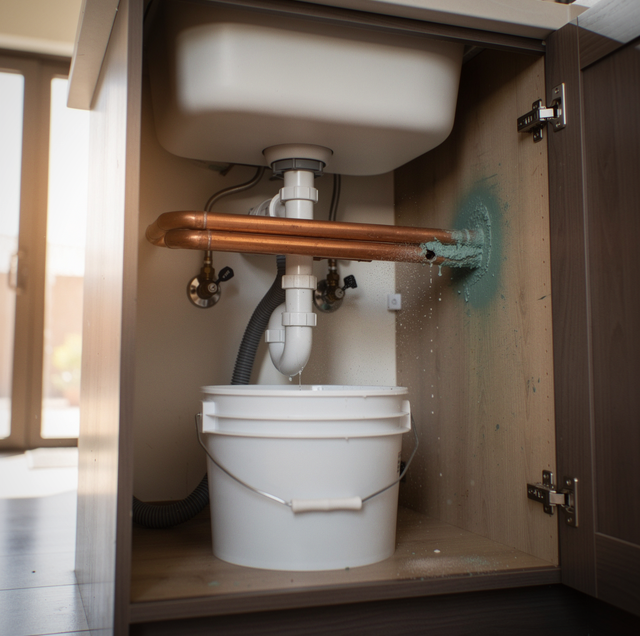
A few inches off a joint, a fine mist hangs in the air, or a small bead of blue-green crust sits on a copper line that otherwise looks sound. Run a hand along the pipe, and the metal feels solid on both sides of that spot. The wall gave out from the inside, at one point, while every inch around it held.
Copper pipe holds up for a long stretch of normal use, so a leak this small and localized throws most homeowners off. It isn't rust working in from the outside, the way it would on an iron fitting. Something inside the pipe wore a hole through the metal while the water kept running, invisible until the crust or the spray gave it away. What opened that hole starts with the corrosion pattern itself, then the conditions that set it in motion.
A pinhole spraying onto wiring or a light fixture is an electrical hazard, and a hidden leak inside a wall can cause mold and structural damage before it's ever seen. Shut off the main and call a plumber.
Pitting Corrosion: One Weak Point in an Otherwise Sound Wall
The protective layer: copper protects itself as it ages. In a healthy line, dissolved copper reacts with oxygen to form a thin, dull layer called cuprous oxide on the interior wall. That layer isn't decorative; it keeps the metal underneath from reacting further with the water passing over it. Uniform corrosion, in which the layer wears evenly along a long section, is slow and rarely produces a leak on its own.
Pitting is a different pattern. The protective layer breaks down at one small point, maybe a flaw in the copper itself, a nick from installation, or a spot where turbulence disturbs the water at the wall. Once that opening forms, it becomes the path of least resistance: metal continues dissolving from that point, while the surrounding wall, still protected by its oxide layer, remains intact. It's the same pattern as rust starting at a single chip in a painted metal surface and working under the paint from that one opening, spreading beneath the surface far more than the chip suggests, while the metal around it stays untouched. In a copper pipe, that undercutting works through the wall thickness instead of sideways, and one weak point eventually breaks all the way through.
Water Chemistry Sets the Conditions Underneath
The conditions within the line determine how quickly the oxide layer forms and how likely a pit is to open once the surface is weakened. Low-pH water has more free hydrogen available to react with copper, and low-alkalinity water has less buffering capacity to resist swings in acidity. Hence, a stable layer is harder to form.
Dissolved oxygen and carbon dioxide play a related role. Water that picks up extra oxygen from aeration delivers more of the reactant driving the corrosion reaction, and dissolved carbon dioxide lowers pH on its own.
Municipal water also carries a disinfection residual, usually chlorine or chloramine, to keep the supply free of bacteria. That residual is an oxidizer, and its continuous reaction at the pipe wall is part of what drives pitting in some systems, particularly where chloramine is used instead of chlorine. Mineral content is another input into the same picture.
Flow Velocity and Erosion Corrosion at Elbows and Tight Runs
Pitting from water chemistry is a chemical process. Erosion corrosion adds a mechanical one on top of it. Water moving through a straight run at a steady pace barely disturbs the oxide layer, but water forced to turn, squeeze, or speed up wears at that layer directly.
An elbow or a tee is the classic location, since water changes direction there, and the turbulence at the bend scrubs the interior wall more vigorously than in a smooth straight run. A pipe sized too small for the fixture's demand makes the problem worse everywhere, since water has to move faster through a narrower opening to deliver the same volume. That extra speed keeps scrubbing at the protective layer instead of letting it rebuild, and a wall worn thin mechanically is exactly where a chemistry-driven pit tends to break through first.
Suspended grit adds a second mechanical factor. Fine sediment carried in the water scours the interior wall as it passes, wearing most severely at the same bends and narrow points that erosion and corrosion already target, and debris shed from an aging water heater or a fitting upstream is a common source.
Installation-Era Flaws That Start the Damage Early
Trouble built in at the joint: some pinholes trace back to the day the line went in, not the water that has run through it since. Sweating a copper joint requires flux to help the solder flow and bond, and flux left uncleaned inside the joint continues working after the torch is off. Flux residue is corrosive to copper, which is why a pinhole caused by installation so often appears within an inch or two of a fitting rather than in the middle of a run.
Cutting the pipe leaves its own mark. A tubing cutter that isn't deburred afterward leaves a small ridge of metal curling into the pipe's inside diameter, a rough patch with no protective layer of its own that disturbs smooth water flow and creates the same kind of localized turbulence that erosion and corrosion feed on elsewhere. Careful deburring and clean joints give a line a fair chance at a stable protective layer; residue or burrs left behind build in a weak point before water chemistry does anything at all.
Stray Electrical Current and Grounding Problems
This driver shows up far less often than water chemistry or a mechanical cause, but it's worth ruling out when pitting keeps recurring across the system without an obvious installation or chemistry explanation.
Copper piping is sometimes used, deliberately or as a byproduct of how a system was wired, as a path to ground for part of the electrical system. A small, continuous current running through the pipe wall alongside the water drives an electrochemical reaction where the current leaves the metal, pitting the copper in a way that looks like a chemistry-driven pit but has an electrical cause. Corrosion where copper meets a dissimilar metal, like a steel fitting, has a related cause: two metals in contact with water between them set up a small current of their own. A dielectric union, a fitting designed to electrically isolate the two metals while still passing water, is how a plumber typically isolates that connection. Sorting out stray current takes electrical testing alongside the plumbing inspection.
Copper piping used as an electrical ground path carries live current. Never bond, unbond, or cut into that pipe without an electrician's involvement; that combines an electrical and plumbing hazard beyond a plumbing-only fix.
Pipe Age and Wall Thickness: Type M Against Type L
Every driver above works faster or slower depending on how much metal it has to get through before reaching the pipe's outside. Copper pipe comes in different wall thicknesses, most commonly type M and type L for residential water lines, with type L built to a heavier wall than type M. A thicker wall doesn't stop pitting from starting, but the same corrosion rate takes longer to open a hole in type L than in type M of the same diameter.
Age matters for a related reason. A line installed under older practices and water treatment standards may already be nearing the end of what its wall thickness can withstand, even without an obvious cause in the moment. A newer pinhole in an older system and one in a newer system can look identical, but they point a plumber toward different questions: one bad joint, or a wall thinning gradually and showing in more than one place. A pinhole can also develop under a slab foundation, where confirming a leak calls for an acoustic or electronic leak locator rather than a visual check of exposed pipe.
A quick way to see how the drivers differ:
| Driver | What It Does to the Pipe Wall | What Points to It |
|---|---|---|
| Pitting corrosion | Breaks the protective layer at one point; loss builds there instead of spreading | A single hole in an otherwise sound section, ringed with green-blue crust |
| Water chemistry | Weakens the protective layer system-wide, priming several spots at once | Leaks appearing in more than one place around the same stretch of time |
| Flow velocity/erosion | Wears the wall mechanically, faster at bends and narrow runs | Pinholes clustered at elbows, tees, or an undersized run |
| Installation flaws | Leaves flux residue or a burr that never lets a stable layer form | A pinhole close to a joint, on a line installed some years back |
| Stray current | Drives an electrical reaction at the point current leaves the pipe | Recurring pits with no chemistry or mechanical cause found |
| Age/wall thickness | Sets how long a pit takes to break all the way through | An older type M line failing sooner than a heavier type L run nearby |
How a Plumber Decides Between a Spot Repair, a Section Replacement, and a Repipe
Once the cause is narrowed down, the fix follows from how contained the problem is. A single pinhole with no other pitting nearby, on a line that otherwise checks out, usually calls for a spot repair, cutting out the damaged section and replacing it with new pipe and fittings.
A pattern of pits along one run, or a chemistry result indicating conditions affecting the whole system, shifts the conversation toward replacing a longer section rather than repeatedly patching one spot. Chemistry working against every inch of copper in the house doesn't stop at the edge of a repair, so a spot fix buys time on one leak while similar wall loss continues elsewhere.
A full repipe becomes the practical answer when age, wall thickness, and a chemistry-driven cause all point the same direction, or when pinholes have already turned up in more than one location. The decision comes from the water test, the pipe on inspection, and how much sound wall thickness is left, a judgment a plumber makes in person rather than a call that follows automatically from any single factor.
Frequently Asked Questions
Not always. Most drivers above start on the interior wall, but copper can also corrode from the outside when it sits against damp concrete, framing lumber, or wet spray-foam insulation. That contact traps moisture against the exterior and starts a separate process, so a pinhole in masonry deserves its own look rather than an assumption it matches an interior cause.
Temperature affects how fast the reactions behind pitting move. Hot water speeds up that chemistry the same way heat speeds up most reactions, so a hot line can develop a pinhole sooner than the cold line beside it, even when they carry the same water.
It can be, for different reasons than a municipal supply. A well draws through its own pressure tank and, on many systems, an iron or sediment filter, fixtures a municipal line doesn't have, and either one can shift the water's chemistry between the source and the tap. A saturation index test, which checks whether water tends to dissolve or precipitate minerals, is part of what a well-specific water test provides beyond a standard check.
Often, yes. A moisture meter reads higher moisture levels behind a wall before it's visible, and an infrared camera detects the temperature difference where water escapes into a cavity, letting a plumber narrow down the location before opening any finished surface.
No. The blue-green crust around a pinhole is a mineral deposit, not a repair. It can slow a drip for a while by partially blocking the opening, but the underlying wall loss continues, and the opening typically continues to enlarge rather than seal itself.
It can, in either direction. Installing a softener or filtration system changes the water chemistry that existing copper is exposed to, and pipe that reached something close to equilibrium with the old water can see that shift once treatment changes what's flowing through it. A plumber treats a water test taken before that change as outdated once the treatment setup changes.
Get a Water Test and Pipe Assessment — find out whether it is one weak joint or a system-wide risk before it becomes a bigger repair. Flow Tech Plumbing serves Peoria and the Valley. ROC #347159. Call (623) 267-2703.
