
Water Softener Stopped Working? Five Places It Breaks
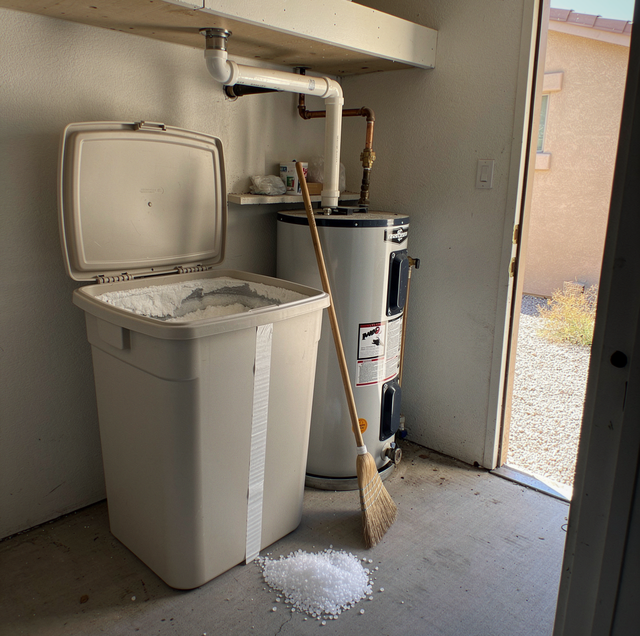
The soap stops lathering first. You notice it in the shower, where the bar leaves a curd on the tile, and the glass door has a dry drag under your hand a week after you cleaned it. Out in the utility closet, the softener sits as it has for years, lid on, tank full of salt, nothing beeping.
Five links carry that water, and hard water at the tap is the one symptom all five produce. The controller has to command a cycle, the brine tank has to hold usable brine, the injector has to draw that brine through the bed, the resin has to still be capable of exchange, and the unit has to be in service rather than bypassed. One symptom, five causes, and two observations sort them: what your salt level does over two weeks, and what the valve does when you force it to run.
The chemistry underneath is a single exchange. The tall tank holds a bed of resin beads carrying sodium ions, and because that resin holds calcium and magnesium more tightly, hardness passing down through the bed stays behind while sodium leaves with the water. The exchange is finite: once the open sodium sites are gone, hardness passes straight through to your taps.
Regeneration resets it. On a clock or a gallon count, the control valve pulls concentrated salt solution from the brine tank through the resin. That concentration of sodium reverses the exchange: calcium and magnesium let go, wash to the drain, and the beads reload. The valve rinses out the spent brine and refills the tank.
A Dead Controller Means Hardness Returns and Stays
The control valve on top of the tank is a motor-driven piston or disc stack, driven by a timer or a meter counting gallons. If the motor never turns, nothing happens. Power is the first suspect: an unplugged adapter behind a shelf, a tripped receptacle shared with a garage freezer, a failed low-voltage supply. After that, the controller board, a seized drive motor, or a stripped gear on the drive cam, and grinding or clicking from the control head, are the drive train failing out loud. Any of them parks the valve in service position permanently, and so does a unit left in bypass after a repair, isolated from the water line and unable to cycle at all.
The signature is easy to read: hardness comes back and never lets up, and the salt level does not move for a month, because only a brine draw consumes salt.
A cubic foot of standard softening resin removes 20,000 to 30,000 grains per regeneration, depending on salt dose, and federal water-use estimates put an average household above 300 gallons of water a day. At 15 grains per gallon, that is about 4,500 grains into the bed daily, so a two-cubic-foot unit exhausts in a week and a half and passes raw water to you from then on.
A Salt Bridge Leaves the Tank Looking Full
Salt dissolves only where water touches it, in the few inches of brine standing at the bottom of the tank. Recrystallizing against the wall, it can set into a hard crust spanning the full width. The brine beneath is drawn out in the next cycle and never replaced because the salt above now rests on a shelf with an air gap beneath it. Lift the lid and the tank looks full. Reach into the brine well, and your hand comes out dry.
Everything visible during this failure is normal, which is why it runs for weeks. The valve cycles on schedule, water goes to the drain, and the bed gets rinsed with something close to plain water, so it comes back with a fraction of its sites reloaded. Hardness returns in stages: soft in the morning after a cycle, hard by evening, then hard all day.
Mark the salt line inside the tank with tape, then read it two weeks later. A controller display reports the cycles it commanded; the tape reports the brine the softener actually drew. An unmoved line settles which happened.
You find a bridge with a broom handle pushed straight down through the salt: the bridge gives way in one piece, with loose space beneath it, and solid salt resists the whole way down. Break the crust up without driving the handle into the tank wall, which is thin polyethylene. Then keep the tank no more than about two-thirds full, so less salt stands above the brine to bear down on a crust and hold it together. Coarse pellets bridge less readily than fine grades for a related reason: larger particles leave larger voids, so a damp crust forming across the top has less contact area to span. Fine grades fail the other way too, mushing into a recrystallized slush at the tank bottom that never becomes usable brine.
A Fouled Injector Runs the Cycle and Changes Nothing
The valve does not pump brine. It pulls it, with a venturi injector: water forced through a narrow nozzle speeds up and drops in pressure, and that low-pressure throat sucks brine up the brine line into the resin bed. Suction that gentle needs three conditions holding at once.
The nozzle and throat are small enough that a scale flake, a grain of iron sediment, or salt fines can plug them. A drain line that is kinked, scaled at an elbow, or run higher than the valve's rated lift raises backpressure at the injector outlet and cancels the pressure drop that creates the suction. And the valve's specification sheet gives a minimum operating pressure; below that figure, the venturi never establishes its differential. Low inlet pressure is its own diagnosis, upstream of the softener.
The signature is a cycle that performs and accomplishes nothing: water leaves the drain line on schedule, the valve advances through every position, and your tap is still hard. If the refill works while the draw does not, evidence accumulates in the brine tank, where fresh water enters every cycle, and none comes out, and the standing water rises above the salt.
The brine line ends at an air check in the brine well, a float valve that seals before the tank empties so the injector never pulls air. A stuck one breaks the suction the moment air reaches the nozzle, and the result is the same as a plugged injector.
Chlorine and Iron Wear Out the Resin Itself
Softening resin is a crosslinked polystyrene bead studded with sulfonate exchange sites, and both halves of that structure can be destroyed while the rest of the unit works perfectly. Free chlorine oxidizes the crosslinks that hold the bead together, causing it to swell, soften, permanently lose capacity, and break into fragments. The loss tracks the total chlorine the bed has passed, so a softener fed chlorinated water reaches that condition in fewer years than the same unit on a chlorine-free supply.
Iron does its damage by coating. Dissolved ferrous iron enters the bed clear and colorless, meets oxygen, and precipitates as ferric iron on the bead surface, blocking exchange sites under a rust-colored film that brine will not lift. Fouling and stripping are a race: every service run deposits iron, every regeneration lifts part of it. Where your raw water carries enough iron that a run deposits more than the following brine cycle removes, the film thickens cycle over cycle, and the bed behaves as exhausted, however much salt reaches it.
The third way to lose a bed is physical. A cracked distributor tube or a broken bottom basket lets beads escape, and a bed that has lost volume has lost capacity in proportion. Amber-brown spheres under a millimeter across, caught in a screen, are resin, and they mean a tank internal has failed.
All three share one signature: everything cycles correctly, salt drops on schedule, and hardness returns anyway. An iron-reducing resin cleaner dosed into the brine tank strips some iron fouling off the beads, but nothing restores a bead whose crosslinks are broken, and nothing replaces resin that washed down the drain. Those beds get rebedded.
Two Hardness Readings and a Forced Cycle
A hardness reading on both sides of the unit separates a stopped valve from a weak one. A titration drop kit reports grains per gallon and resolves finer than a test strip, which matters because the gap between zero and four grains is the whole diagnosis. Confirm which side of the softener your outdoor hose bibs are on before you use one as the raw sample; they are plumbed ahead of the unit in some houses and downstream of it in others.
Two matching readings mean no exchange anywhere: the valve, the bypass, or a bed with nothing left to give. A treated reading below raw but above zero means partial exchange, which points at weak brine or a shrunken bed rather than a stopped valve.
Then force a regeneration, which on a residential controller is a held button or a turned knob, and watch in order: whether the motor drives the valve through its positions, whether water leaves the drain line during backwash, whether the brine well level drops during the draw. Each of those names the link that parted.
Frequently Asked Questions
A complete residential regeneration runs roughly 90 minutes to two hours, split across backwash, brine draw, slow rinse, fast rinse, and brine refill. Set the start time for the small hours, since a cycle interrupted by demand ends early, leaving the bed partly loaded. One finishing in fifteen minutes is skipping stages.
An empty tank does not hurt the resin. The bed stays loaded with hardness and passes it through until brine reaches it again. The edge case is a bed left exhausted for months on iron-bearing water, where iron keeps depositing with no brine cycle to strip it. After a long empty stretch, run two regenerations back-to-back: one cycle on a fully loaded bed can leave sites still occupied.
A metered valve measures gallons and needs your hardness figure to know when to regenerate, so that one setting determines its entire schedule. Program it from a lab or drop-kit test of the raw water. If your water carries dissolved iron, add four grains per gallon of compensated hardness for every part per million of iron, since the bed spends real capacity holding it.
Yes, and the difference shows up at the air check. Evaporated pellets are close to pure sodium chloride, while rock salt carries insoluble mineral matter that settles out as the salt around it dissolves. That residue works into the brine well and can hold the air check float off its seat, and a float that cannot seal lets the injector pull air mid-draw.
Direction tells you which internal broke. Beads that reach your fixtures came up through the bottom distributor basket into the riser tube during downflow service, so check a faucet aerator, washing machine inlet screens, and a toilet fill valve strainer. Beads you never see, on a bed that keeps losing capacity, left up the drain line during upflow backwash past a damaged upper screen.
Its bypass position. On a single-lever bypass, the handle is in line with the valve body, and a quarter turn off is bypass. On a three-valve bypass, service means the inlet and outlet valves open, and the middle bypass valve closed. Read those positions before you conclude anything inside the tank has failed.
Hard water back at every tap has a testable cause — a technician can check the bed, the brine draw, and the valve in one visit before anything gets replaced. Flow Tech Plumbing serves Peoria and the Valley. ROC #347159. Call (623) 267-2703.
