
Trenchless vs Traditional Sewer Repair: Which Saves Your Yard?
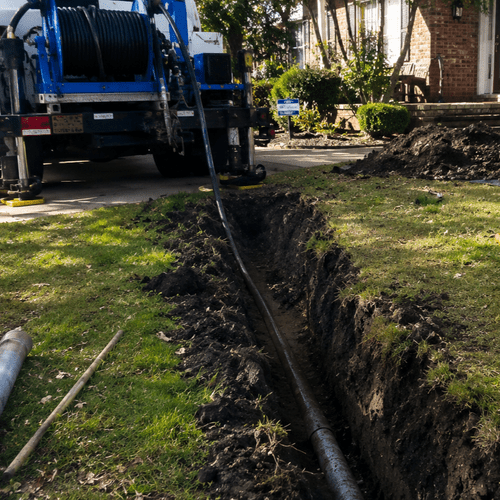
Quick Answer: Trenchless repair fixes the pipe from the inside through one or two small access points, so your yard stays intact and the job often wraps in a day. Traditional dig-and-replace tears a trench to the pipe and swaps it out — slower and messier, but the right call for a fully collapsed line or one that needs rerouting. Which one fits depends on the pipe's condition, its depth, and what's sitting on top of it.
Your sewer line finally backed up for the last time, the plumber ran a camera down it, and now you are staring at two quotes that sound like completely different projects. One promises to fix the pipe without digging up your yard. The other wants to trench across the lawn you just reseeded. Both can solve the problem — the trick is knowing which one your situation actually calls for.
How Traditional Sewer Repair Works
Dig-and-replace is the method that's been around for as long as there have been sewer pipes. The crew locates the damaged line, then excavates a trench straight down to it — sometimes a few feet deep, sometimes much more if the pipe runs under a slab or out toward the street. They remove the broken section, lay new pipe, and backfill.
It's invasive, and there's no pretending otherwise. The trade-off is total access. Once the pipe is exposed, the crew can see exactly what they're dealing with, reroute a line, change its slope, or replace a section that's beyond saving. For a pipe that has fully collapsed or pancaked flat, there's nothing left for a liner to grab onto, so digging is the only honest answer.
Around here, the digging itself comes with a local twist. Much of the Valley sits on caliche — a cement-hard layer of calcium carbonate that can run inches to feet thick. Caliche resists the shovel and the excavator, making a traditional trench slower and more disruptive than it would be in soft soil. That single fact is a big reason no-dig methods caught on so fast in the Phoenix area.
How Trenchless Sewer Repair Works
Trenchless is the newer family of methods, and it flips the approach. Instead of digging down to the pipe, the crew works through one or two small access points and rebuilds or replaces the line from the inside. Two methods cover most jobs.
With cured-in-place pipe, or CIPP, the crew slides a resin-soaked felt liner into the old pipe and inflates it against the walls. The resin hardens into a smooth, jointless pipe-within-a-pipe — often rated to last 50 years or more. It seals cracks, blocks root intrusion at the joints, and actually improves flow because the new interior is slicker than old cast iron or clay ever was.
Pipe bursting handles the lines too far gone to reline. A cone-shaped bursting head gets pulled through the old pipe, fracturing it outward into the surrounding soil while it tows a brand-new pipe in behind it. You come out the other side with a full replacement and no trench — just two small pits at either end.
Both methods lean on a camera inspection first. A plumber pushes a video camera down the line to map the damage, measure the pipe, and confirm whether trenchless will even work. That diagnosis is what tells you which path you're on before anyone touches the yard.
The Honest Comparison
Neither method is "better" in a vacuum — they're built for different problems. This table lays out the two side by side on the factors that actually decide it:
| Factor | Traditional dig-and-replace | Trenchless (lining/bursting) |
|---|---|---|
| Yard and hardscape | Trench across lawn, driveway, or patio | One or two small pits; surfaces stay intact |
| Typical timeline | Two days to a week, plus restoration | Often a single day |
| Best for | Collapsed pipe, rerouting, slope changes | Cracked, root-filled, or corroded pipe still holding shape |
| Restoration after | Replant, repour concrete, rebuild hardscape | Little to none |
| Lifespan of repair | 50+ years with new pipe | 50+ years with CIPP liner or new burst-in pipe |
| Caliche-soil impact | Major — hard digging slows the job | Minimal — almost no excavation |
The pattern is easy to read once it's laid out. If the pipe still holds its shape, trenchless usually wins on speed and on saving your landscaping. If the pipe is crushed, badly misaligned, or needs to move, traditional digging earns its keep.
When Digging Is Still the Right Call
Trenchless gets the headlines, but it isn't magic, and a good plumber will tell you when it doesn't fit. A line that has collapsed completely leaves no host pipe for a liner. A pipe with a major belly — a sagging low spot where waste pools — needs its slope corrected, and you can't re-grade a pipe from the inside. The same goes for rerouting a line around a new addition or a tree you're not willing to lose.
There's also the matter of access. Pipe bursting and lining need entry and exit points, and on some properties, the geometry just doesn't cooperate. There are lines where the only sane fix was to open the ground, because forcing a trenchless method onto the wrong pipe is how you end up paying twice.
When Trenchless Is the Smarter Money
For the majority of aging residential lines, though, trenchless is the call that saves you grief. Clay and cast-iron pipes in older Valley homes tend to fail the same way — hairline cracks at the joints, then roots working in through those cracks looking for water. A CIPP liner seals all of it in one shot without disturbing the mature landscaping or the driveway sitting on top.
The savings aren't only in the repair. Traditional digging carries a second, hidden bill: tearing out and rebuilding everything above the pipe. Sod, irrigation, pavers, concrete, a section of patio — that restoration can rival the pipe work itself. Skip the trench, and you skip that whole line item. Factor in caliche, which makes every dig harder, and trenchless often comes out ahead on total spend, even when the method itself costs more per foot.
Before you approve any sewer quote, ask for the camera footage. A reputable plumber will show you the actual condition of your line on video — that recording is what proves whether you truly need a full dig or whether a liner will do the job.
Frequently Asked Questions
Yes, when it's done right. A cured-in-place liner is rated for 50 years or more, and a pipe-bursting job installs brand-new HDPE pipe that carries a similar lifespan. The smooth interior of a liner also resists root intrusion and scales better than the old, jointed pipe it replaced, so in some cases, the repaired line outlasts the original.
A camera inspection settles it. The plumber sends a video camera down the line to check whether the pipe still holds its shape and how bad the damage is. A cracked or root-filled pipe that's still round is a strong candidate for lining; a collapsed or badly sagging pipe usually needs excavation.
Per foot, the trenchless equipment and materials are often priced higher. But the full picture frequently lands the other way, because traditional digging adds the cost of restoring everything above the pipe — landscaping, concrete, and hardscape. In caliche-heavy parts of the Valley, where excavation is slow and labor-intensive, trenchless can be the cheaper total once restoration is counted.
Many trenchless jobs finish in a single day, since there's little to excavate and the liner cures in a few hours. Traditional dig-and-replace usually runs two days to a week, depending on depth, soil, and pipe length — and that's before you restore the surface, which adds more time.
Traditional repair opens a trench along the pipe's path, disturbing whatever lies above the line. Trenchless needs only one or two small access pits, which keeps lawns, driveways, and patios mostly untouched. That difference is the single biggest reason homeowners reach for a no-dig option.
A properly installed liner seals the joints and cracks where roots get in, so the same pipe shouldn't be reinvaded. Roots can still find another, untreated section of the line down the road, which is why the camera inspection looks at the whole run, not just the failed spot. Keeping aggressive trees away from the line is still the best long-term defense.
Match the Method to the Pipe, Not the Marketing
The best sewer repair is the one that fits your specific line — its condition, its depth, and what's sitting on top of it. Trenchless saves your yard and your weekend when the pipe still has structure to work with. Digging is the durable solution when the line is crushed or needs to be moved. Get the camera down there first, look at the footage with your own eyes, and let the pipe decide.
Facing a sewer repair and not sure which method you actually need? — Start with a free camera inspection, see the real condition of your line, and get an honest recommendation either way. Flow Tech Plumbing serves Peoria and the Valley, with trenchless options backed by a lifetime transferable warranty on qualifying work. ROC #347159. Call (623) 267-2703.
