
You press the handle, hear the tank empty, and watch the bowl do a half-hearted swirl instead of a real turn. Paper drifts toward one side and stays there. A second press might finish the job. It might not, and the water just creeps back to the same level it started at.
A flush is not one motion. It is a short sequence: water drops out of the tank; some exits through the rim; the rest exits through the siphon jet at the bottom front of the bowl; and that surge fills the trapway until it seals with water and pulls everything through by suction. A weak flush means that sequence lost force somewhere before the pull finished, and where it lost force points to what needs attention. Working from the tank down to the line answers that in order.
The Tank Has to Deliver Its Full Charge of Water
Everything downstream depends on how much water actually leaves the tank in that first second or two. The tank has a marked fill line, and a float-operated fill valve is supposed to shut off when the water reaches that level. If the float is set too low or a worn fill valve shuts off early, the tank holds less than its rated volume and delivers a smaller charge to the bowl. Less water means less force at the siphon jet, and the flush stalls before the bowl fully clears.
Check this first: Lift the tank lid and look at the water level against the marked line once the tank has finished refilling. If it sits noticeably below that mark, the float needs adjusting, whether that means bending an arm on an older ball-float valve, turning a small screw, or sliding a clip on a float-cup valve.
The Flapper Decides How Long the Water Runs
The flapper is a rubber seal that sits at the tank's base, and its job is to stay open long enough for the full charge to empty into the bowl, then drop and reseal so the tank can refill. Chain slack has to land in a narrow range for that to happen. Too little slack holds the flapper propped up off its seat, so it never fully reseats, and the tank leaks past it between flushes instead of holding a full charge. Too much slack means the chain cannot pull the flapper all the way upright: it lifts only partway, cutting the flush short. A flapper that has gone soft, warped, waterlogged, or picked up mineral deposits on its sealing edge can drop early or leak even when the chain is correct, so water trickles past it instead of surging through.
With the flapper seated, the chain should hang with about a half inch of slack. If you replaced the flapper yourself, check that its size matches the flush valve opening; a 2-inch flapper on a 3-inch valve seats and closes wrong.
Check this next: With the lid off, press the handle and watch the flapper. It should snap fully open and stay clear of the opening until the water has visibly dropped, then fall flat and seal.
Mineral Deposits Can Choke the Rim Holes and Siphon Jet
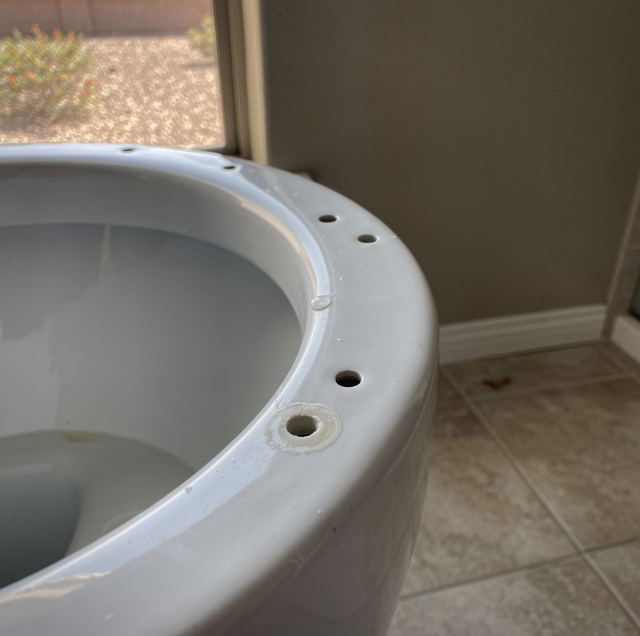
Supply water carries dissolved minerals, and they come out of solution where water slows and sits between flushes. The small holes under the rim and the siphon jet at the front of the bowl are prime spots for a rough crust to build. Where the incoming water carries a heavy mineral load, that crust is a real suspect for a flush that has weakened gradually with no other change; where the mineral content is low, a crust is a weak explanation, and the cause is more likely elsewhere in the sequence. Once a crust does form, the tank still empties and the water still moves, but less of it leaves the rim and jet at full force, and the flush loses the burst it needs to seal the trapway and pull waste through.
This kind of restriction is easy to miss because nothing looks obviously broken. The tank fills and drains on schedule, the flapper opens and closes correctly, and the flush still just feels underpowered. A close look under the rim, checking for a chalky ring around each hole or a rough buildup around the siphon jet opening, usually confirms it.
The Trapway's Shape Sets How Much Siphon the Flush Can Build
Every toilet has its own trap built into the base, a curved passage the bowl's contents travel through before they reach the drain line. The trapway's diameter and the tightness of its curve set how much siphoning vacuum a flush can generate. A narrower or more sharply curved trapway requires a stronger, more concentrated surge of water to fill it completely and start the siphon; a wider, straighter one forms that seal more easily with the same volume of water.
An object lodged inside the curve of the trapway itself, rather than farther down the drain line, produces the same weak, incomplete flush every single time, with no gurgling and no effect on any other fixture. A toy, a dense wad of paper, or a wipe that never should have gone in is the usual culprit, and it sits close enough to the bowl that a closet auger, run in through the bowl rather than a floor cleanout, is usually what clears it.
A Partial Restriction Past the Trap Steals the Same Water
Beyond the toilet's own trap, water travels through a branch line before it joins any other drain in the house. A partial restriction there, built up gradually rather than in one incident, does not stop water outright the way a full clog does. It narrows the path enough that water backs up slightly with every flush, so the bowl never fully clears even though the tank emptied on schedule and the trapway is clear.
The pattern that comes with this cause is what separates it from the causes above. A tank, flapper, or scale problem behaves the same at every flush and affects only this one toilet. A partial branch restriction does not stay fixed: it can hold back paper and waste, so how well the bowl clears varies from flush to flush, and a second flush may be needed to finish the job.
Pouring a chemical drain cleaner into a toilet with a partial clog won't clear the trap or the line, and it leaves caustic liquid sitting in standing water. A plumber who later reaches into that bowl faces a real risk of chemical exposure.
Two other patterns point away from this toilet entirely. If the weak flush is accompanied by gurgling elsewhere in the house, the fault points past this toilet to a vent or a shared line, rather than to water losing force in this line, and that is a different mechanism to chase. If more than one fixture is acting up at the same time and drains at the low end of the house are the first to back up, the shared line every fixture feeds into is the more likely fault, and that calls for a different kind of look than this toilet alone.
Matching the Symptom to the Cause
| What you see | Likely cause | What to check or do |
|---|---|---|
| Weak swirl every flush; tank refills to the normal mark | Flapper closing early or not lifting fully (chain too slack, worn flapper) | Watch the flapper lift fully open; adjust chain slack |
| Weak swirl every flush; water in tank sits below the fill mark | Fill valve shutting off early | Adjust or replace the fill valve float |
| Flush sounds strong, but the bowl still leaves paper, with no other change | Scale narrowing the rim holes or siphon jet | Inspect under the rim; usually needs a service visit |
| Same weak flush every time, no gurgling, no effect on other fixtures | Object or restriction inside the trapway itself | A closet auger through the bowl, run by a technician |
| Bowl clears inconsistently; a second flush may be needed | Partial restriction building up past the trap | Camera inspection |
| Weak flush plus gurgling elsewhere, or other drains backing up too | Vent or shared main line issue, not this toilet alone | Different diagnosis; stop running water if drains are backing up |
Frequently Asked Questions
No. A true clog announces itself immediately: the bowl level rises within the first few seconds of the flush instead of dropping, because the trap or the line beyond it can't accept the water at all. A weak flush still drops the bowl level and swirls; it just doesn't finish pulling everything around the bend. If the water climbs instead of falling, stop flushing and treat it as a clog rather than a weak-flush problem.
Toilets made for sale today are rated at 1.6 gallons per flush or less, and many carry a 1.28-gallon water-efficiency label. A toilet built to that rating isn't underpowered by the rating itself. A flush that feels weak on a current water-efficiency-labeled model still traces back to the tank, the flapper, or the fittings, not to the lower gallons-per-flush figure.
Many replacement flappers for 1.6-gallon toilets feature an adjustable dial or float that sets how long they remain open before resealing. A universal flapper left on the wrong setting closes early on every flush, which reads exactly like a weak toilet even though the chain, the seal, and the fill valve are all otherwise fine. Checking that setting against the toilet's actual flush volume is worth doing before swapping any parts.
Yes. A toilet's built-in trapway is considerably wider than the P-trap under a bathroom sink, which is why a toilet passes most solids that would stall a lavatory drain. But anything wider than that opening, or anything that swells once it's wet, can still lodge inside the curve.
Not usually, and it can create a new problem. The volume that actually leaves the tank on a flush is capped by the height of the overflow tube inside it, not by how high the float lets the water rise. Set the float above that tube's opening and the extra water just spills continuously down the overflow tube into the bowl instead of adding force to the flush, which shows up as a tank that never stops running quietly.
Partly, but the more useful comparison is a model's flush-performance test score, published on its spec sheet, which states how many grams of solid waste it cleared in testing at its rated flush volume. A toilet with a low performance score can flush weak from day one even with a healthy tank, flapper, and trap. That's a spec worth checking when replacing a toilet that has always flushed weak, but it has little to do with a toilet that used to flush fine and suddenly stopped, which points to one of the failures above instead.
Schedule a toilet flush diagnosis — find out whether the issue is in the tank, the trap, or the line before a partial restriction turns into a full clog. Flow Tech Plumbing serves Peoria and the Valley. ROC #347159. Call (623) 267-2703.