
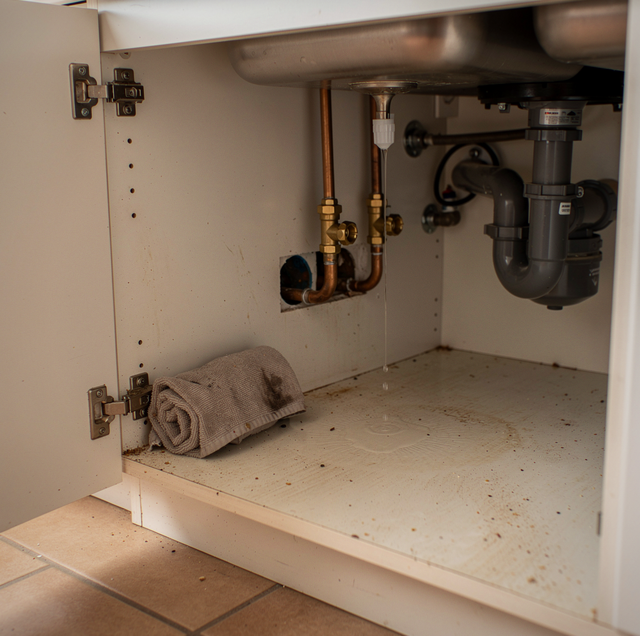
The fastest valve to close is the one nearest to whatever is leaking. Before you step into a wet room to reach it, check whether the water has touched an outlet, a cord, a power strip, or the electrical panel; if it has, stay out of that room and use a valve you can reach from a dry floor, the main house shutoff, or the meter box. If the room is safe and you can see the source, close that fixture's own stop valve. If you cannot see the source, or that valve will not close, go to the main house shutoff and close it. The order matters because each valve in the sequence isolates a larger part of the plumbing: one fixture, then the water heater, then the whole house, then the line at the meter. Work through the sequence until the water stops.
Close the Fixture's Own Stop Valve First
Under a sink, two small valves sit where the supply lines leave the wall or cabinet floor. Behind a toilet, one valve sits low on the wall beside the bowl, feeding the fill valve. A washing machine has a hot and a cold valve in the wall box behind it, and a dishwasher or ice maker has its own small valve on the line that feeds it. These are stop valves.
A burst braided supply hose or a faucet connector that has let go is the failure these valves isolate, and closing one takes seconds. Turn a round or oval handle clockwise until you meet firm resistance. A small lever is closed when it lies across the pipe. The rest of the house keeps its water.
If the handle will not turn, is crusted with mineral scale, or weeps at the stem when you touch it, stop. Pliers or a wrench on an old stem can snap it, opening a bigger leak than the one you started with. Move up to the next valve in the sequence.
Close the Water Heater's Cold-Supply Valve for Hot-Side Leaks
On a properly piped tank water heater, the cold pipe entering the top carries its own valve, a wheel or a lever, close to the tank; if yours has none, go straight to the main. Closing it prevents fresh water from refilling the tank and pushing hot water into the house, while cold taps elsewhere keep running. Use it when the water is hot to the touch, when it is coming from the tank or the pipe running from the relief valve, or when you can trace the leak to a hot line. A tankless unit has a cold-water isolation valve on the inlet pipe underneath it, and it closes the same way.
If the heater is electric, an element switched on in a drained tank can burn out. Once the valve is closed, switch off the heater's breaker, but only if the panel is dry and you can reach it without stepping through water. If the heater is gas, leave the gas valve and the control knob alone. Closing the water side never requires touching them, and if you smell gas, go outside and call the gas utility from there. Keep your face and hands clear of any spray from the tank or the relief pipe, because that water can scald.
Close the Main House Shutoff, and Find It Before You Need It
The main shutoff sits where the water line enters the house. Inside, that is a wall near the water heater, a garage wall, a utility closet, or a basement wall. Outside, it is a valve on an exterior wall or one inside a buried box with a lid.
Foundation type changes how soon you get to it. In a house over a basement or crawlspace, a failed supply line can show itself where it fails, as spray, a drip, or a stained ceiling, and a nearby stop valve may be all you need. In a house on a concrete slab, the same failure can run under the floor with nothing visible to close a valve against, so the main is the first valve that reaches that pipe. A meter dial that keeps moving with every fixture closed shows water leaving somewhere on the property, and on a slab house that somewhere can be under the floor. Finding the break can wait for the plumber once the main is closed.
Two valve types turn up at the main. A gate valve has a round wheel and requires several full clockwise turns; a ball valve has a lever and closes with a quarter turn when the lever lies across the pipe. A gate valve that has sat untouched for years may have a stiff or brittle stem, so use steady hand pressure only. Do not reach for a pipe wrench or a cheater bar, because a snapped stem leaves the house with no working shutoff of its own, and the meter-box valve becomes the only way to stop the water. Keep clear of the pressure regulator, a brass bell-shaped body on the line just after the main; its adjusting screw is not a shutoff.
Tie a bright tag to the main shutoff and photograph it with your hand beside the handle. Text the photo to every adult in the house, so someone can find and close it while you are still on the phone.
Check the Meter-Box Valve and Who May Operate It
When the house has no working main, or it will not close, the next valve is at the water meter: a concrete or plastic box set in the ground near the curb or the property line. Wear gloves and lift the lid with a hook or a screwdriver, never your fingers, since insects and spiders nest under it. Inside is the meter, with its dial and a small leak indicator, and on its street side a valve built for a special T-shaped key.
That street-side valve may belong to the water utility, not to you. Some utilities allow homeowners to close it in an emergency, while others reserve it for their own crews. Follow your utility's rules and call its emergency line if you are unsure; they can close it from the street. A second valve on the house side of the meter, if there is one, is part of the house and operates like any other main. Leave the meter itself alone: no wrench on its fittings, no prying at its lid.
Once the Water Is Off, Relieve the Pressure and Stay Out of the Electrics
Closing a valve stops incoming water, but the downstream pipes still hold water under pressure and will keep pushing it out of the break. Open the lowest faucet you can reach, such as an outdoor hose bib or a ground-floor tub tap, and then a hot tap, so the lines drain and the flow at the leak dwindles to a drip.
Water that has reached an outlet, power strip, cord, or the electrical panel makes the room unsafe to enter. Do not touch switches or unplug anything; call an electrician or the electric utility for the panel to make it safe first.
Water that is still falling from a ceiling light fixture or a bulging ceiling is the same situation, so keep the switch off and stay out from under it.
Which Valve Held Tells You Where the Break Is
If a fixture stop held it, the failure is in that fixture's supply line or connector. If the water heater's cold valve held it, the break is on the hot side, between the tank and the taps. If only the main held it, the break can be anywhere on the house side, including under the slab. If only the meter-box valve held it, the break sits between the meter and the house valve, or the house valve itself has failed. Tell the plumber which valve it was and when you closed it, and photograph the meter dial.
Then choose the call. A break anywhere on the house side of the meter is the responsibility of a licensed plumber. Water still flowing in the yard between the street and the meter, with your own valve closed, belongs to the water utility. A gas smell is from the gas utility; call from outside. Water at electrical equipment is an electrician's responsibility. Do not wrap, clamp, or tape the break yourself; a closed valve holds the water back for as long as it takes someone to arrive.
A shutoff valve is the one piece of plumbing that rewards being touched before the day you need it. The household that has found the main, tagged it, and closed it once in calm weather loses minutes in an emergency instead of an afternoon.
Frequently Asked Questions
Close it until it meets firm resistance, then stop. A multi-turn compression stop or globe valve seals by pressing a rubber washer against a seat, and if you crank past that point, the washer crushes and the valve weeps the next time it is used. A quarter-turn ball valve stops itself at the end of its quarter turn, so there is nothing more to tighten.
Some flow for the first minute or two is the pipes draining. Water that keeps running at full strength after that has other causes: a gate valve whose disc has separated from the stem spins freely and seals nothing, and a branch tapped in ahead of the valve, such as an irrigation feed, keeps pouring. If the open faucet does not fall to a trickle, move on to the meter-box valve or the utility.
No. Tub and shower valves in some older homes have no separate stop, and some valve bodies hide small screwdriver-slot stops behind the trim that a plumber operates. An outdoor hose bib may have its own stop on the pipe feeding it from inside the wall or garage; one without it can only be isolated at the main.
Wait for the repair if the leak is still open. To restore water to the rest of the house, open the main slowly while the highest faucet in the house remains open, so trapped air can escape; you may hear spitting and sputtering as that air leaves. Then close the faucets and watch the repaired area and the meter's leak indicator for movement.
Tie the test to a task you already do on a schedule, such as changing smoke-alarm batteries. Open the lowest faucet, close the main until it stops, and watch the faucet fall to a trickle, then open the main fully again. If the handle needs force, or water shows at the stem afterward, tell a plumber and stop pushing on it.
Yes, if the bowl keeps rising. Lift the tank lid and hold the float arm up to stop the refill, then close the stop valve behind the toilet clockwise. Water that has overflowed from a blocked drain is wastewater, so keep children and pets out of it until it is dealt with.
Request emergency leak repair — a licensed plumber can find the failed line and fix it while your closed valve holds the water back. Flow Tech Plumbing serves Peoria and the Valley. ROC #347159. Call (623) 267-2703.