
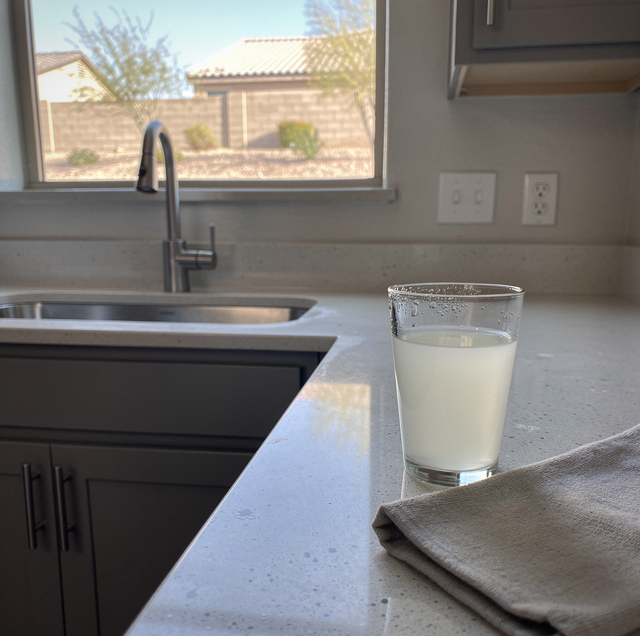
You have filled a glass at your kitchen sink, and it has come out white. Not rust-tinted, not gray, and nothing you can see floating in it. White the way skim milk is white, evenly, top to bottom, and it is standing on your counter now.
Watch it for three minutes. That glass will answer your question before anyone you call can, because the same white water can be air the line could not keep or something it carried, and the two do not behave alike.
One is air the water was holding under pressure and cannot hold once it reaches your tap. The others are things the water is carrying to you, and those are the ones that deserve a name of their own.
What Clears First in the Glass?
No tools are needed. Fill a clear glass with cold tap water, set it on the counter, and leave it for three minutes. Common utility troubleshooting guidance for discolored water puts the reading in one line: fill a glass, wait three minutes, and if the water clears from the bottom to the top, the haze is tiny air bubbles. That instruction is written for utility customers in general and describes the glass in front of you.
Direction is your signal, because the two things that turn water white move opposite ways. A gas bubble is less dense than the surrounding water, so it rises, and the clear zone travels up the glass behind it. A mineral fragment or a grain of silt is denser, so it falls, and the clear zone travels down while a dusting gathers at the base. A third outcome has no direction.
Air the Water Could Not Keep Under Pressure
Air dissolves in water, and the amount it can hold is determined by two conditions. It is a basic property of water: the solubility of air in water increases with increasing water pressure and decreasing water temperature. Water sitting in a pressurized distribution main carries more gas than the same water could hold if left open in a bucket on your counter.
That arrangement ends the instant the tap opens. Releasing the water to atmospheric pressure brings the dissolved air out of solution as millions of tiny bubbles, which is what makes the water look cloudy or milky. No bubble is large enough to pick out by eye. There are enough of them to scatter light in every direction before it reaches you.
Two things move the gas load your water is carrying. The water is warmer when it reaches a house in summer than in winter, and it warms again once it is inside a slab line or a hot attic run, and both cut what it can hold at the moment it arrives. A rising front reports a change in pressure and temperature at your tap, and dissolved material remains invisible through it all.
When Is the Haze Not Air?
Set the glass down and nothing rises. Three minutes pass, and the water is still white, or the top half has gone clear while a layer has collected on the bottom. Either way, the bubbles theory is finished, because gas does not sink and gas leaves nothing behind. Something is suspended in that water, and its size and weight decide which pattern you are looking at.
A glass clearing from the top down behaves like a snow globe just set on a shelf. The load falls out under gravity, coarse and heavy first, fine and light long afterward. A grain of sand drops almost at once. Under Stokes' law, settling speed scales with the square of particle diameter, so halving the width quadruples the wait, and a glass still working at twenty minutes is telling you about particle size as much as about quantity.
Run the same test at the hot tap, then at the cold, and note whether both do it. A haze that appears only on the hot side has come from something between the heater inlet and the spout, which narrows the search to a short list. One that shows at both taps started ahead of the heater. Some glasses hold no front at all, staying evenly white top and bottom because the material is fine enough that settling is too slow to watch.
The glass has a limit. It reports opacity, the property water professionals call turbidity: a measure of water clarity, how much suspended material decreases the passage of light through it, reported in nephelometric turbidity units. Opacity tells you light is being scattered, and there it stops. What is doing the scattering, and what a clear glass carries, both sit outside it. That answer belongs to a certified laboratory or to your utility's published report, and to nothing you can see.
Scale, Sediment, and a Screen That Lets Go
On a municipal line, three sources put something into that glass, by different routes. One rides in from the street. One is generated inside your own house. The third has been sitting at the end of the spout the whole time, collecting quietly while the other two come and go.
Start with the heater, because local water is hard enough to make it the usual answer. The figure for your address comes from your utility's report rather than a regional average. Calcium and magnesium remain dissolved and invisible in cold water, then precipitate as solids when heated, which is why a tank forms a layer that nothing upstream ever sees. Utility guidance on the subject makes the link explicit: hard white particles left in the glass, or clogging an aerator screen, point to a failed plastic dip tube inside the heater or to mineral buildup inside the tank. Haze on the hot side alone is the signature.
The second route is the street. When the flow of water in an area changes suddenly, the same guidance notes, natural sediment sitting inside the pipes gets stirred up and moves. A main repair, a hydrant exercise, or a large nearby draw will do it. A utility's page is a basis for what that utility says about its own system, so the call to make is to yours.
The third is the aerator, and in water this hard it is both the most common of the three and the least examined. It has been catching whatever the line delivered to it, for years.
Public health guidance gives another reason to pull an aerator: a screen clogged with sediment and buildup can let bacteria grow, so it is soaked in white vinegar and scrubbed.
Sorting It Out and When a Test Is the Answer
Work in order, because each step removes a suspect. Fill and watch the cold tap first, then the hot, noting which went white and how long each took. Unscrew the aerator from the misbehaving tap, rinse the screen, and run the test again with it out instead of guessing. If the haze follows the hot side, the heater is next. If it showed up everywhere at once, the utility knows what it did to the main.
That leaves one case: a haze you cannot tie to any of it, or one that changed and stayed that way. Appearance is a prompt to test, and that answer comes from a lab or from whoever publishes your system's numbers. Three minutes, one direction, and the one part the glass can never clear: the screen at the end of your spout.
Frequently Asked Questions
Because both conditions that set the gas load your water holds move during the day. Line pressure in your neighborhood swings with demand, and the water standing in your service line, your slab runs, and your attic piping warms and cools with the house. A first draw after a still night is not the same water, at the same pressure or temperature, as the one you pull mid-afternoon with the house busy.
Often it is the same water reading differently to your eye. Opacity depends on how far light travels through the sample, so a filled tub looks denser than a glass drawn from the same tap, simply because there are more inches of water between you and the bottom. A tub spout also drops water down into standing water, which beats in air of its own.
Any gas is long gone by morning, so anything still hazy that many hours later is not air. Look at your pitcher from the side against a dark background, then run a finger around the bottom and see whether you can feel a film or a fine dusting there. Overnight evaporation can also leave a faint ring at your waterline, which is dissolved minerals left behind as the volume you poured drops.
A strip or drop kit reads dissolved parameters for you, usually hardness, chlorine, pH, sometimes iron. Suspended solids are a different question, and the cloudiness in your glass is a physical property those chemistries do not measure. A certified laboratory can identify what is present in your sample and at what level, which is the result obtained once the appearance remains unchanged.
Turbidity, a measure of water clarity that is reported in nephelometric turbidity units. The annual report published for your system shows the highest detected level and the range of results for the system as a whole over a year of sampling. It describes the water leaving treatment and moving through the mains, so it is the background for the glass in your kitchen rather than a reading of it.
It can, and the mechanism is the screen letting go of what it caught. A screen that has been collecting fine material for years does not hold all of it forever, and a pressure surge or a shutoff can carry some of it loose into the glass. That is why your house can look clear at one tap and hazy at another.
Book a visit if the glass points to something carried rather than air — a licensed plumber checks what the line is delivering to that tap before any fixture or heater is opened. Flow Tech Plumbing serves Peoria and the Valley. ROC #347159. Call (623) 267-2703.