
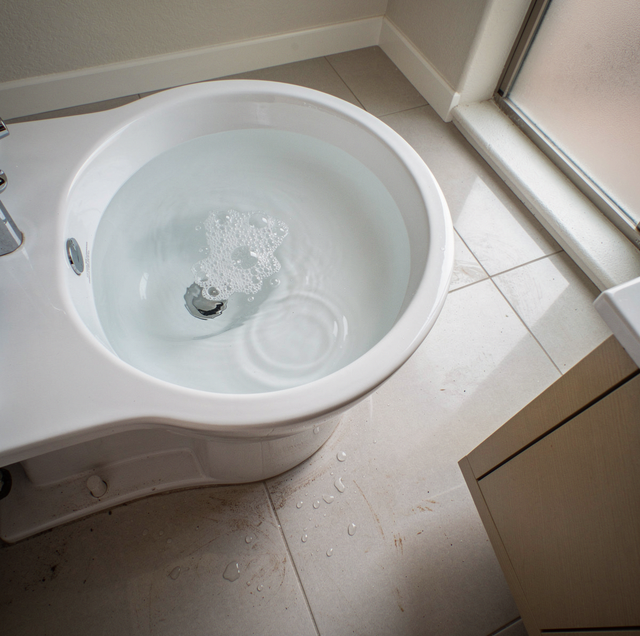
The washer reaches its drain cycle, the pump kicks on, and the toilet down the hall starts to gurgle. The bowl water rocks, drops half an inch, then eases back up. Nothing came out of the toilet, and nothing went in.
What moved was air. The toilet is not misbehaving; it is where air found the easiest opening in a system that could not get air where it needed it. Follow it backward from the bowl, and you walk the route a plumber walks: the washer's standpipe, the branch it shares with the bathroom, whatever vents that branch, the main stack, the roof terminal, the building drain. Six points on that path can send air the wrong way.
Every Drain Line Needs Air Behind the Water
A washer drain pump is not a gentle appliance. Depending on the model, it pushes 10 to 20 gallons per minute, in a sustained burst lasting a minute or more rather than the few seconds a flush takes. A 2-inch drain carrying that rate runs close to full bore, and when a pipe fills edge to edge with moving water, the space behind it has to be filled by something.
That is what the vent system is for: a dry pipe whose only job is to let outside air in behind moving water and let displaced air out ahead of it. The margin it protects is thin. A trap holds roughly 2 inches of standing water, and a pressure difference of about 1 inch of water column is enough to start moving that seal.
The toilet is usually where that shows. Its trap outlet is wider than a sink's or a tub's, its seal sits in the open with a broad surface, and it is often the closest fixture to the laundry.
Suction and Pressure Point at Different Faults
Two opposite conditions produce a gurgle, and they carry very different weight.
The common one is siphonage. Moving water in the branch creates negative pressure behind it; the vent cannot supply air fast enough, and the drain pulls air inward through the toilet's trap seal. The bowl level dips, bubbles break the surface, and it recovers within seconds of the pump stopping. The system is short on air, not on drainage capacity.
The serious one is blowback. The pressure is positive: air ahead of the water has nowhere to escape, gets compressed, and forces its way back out through the trap. The bubbling surges rather than trickles; it can push water up rather than down, and it can carry sewer gas. Positive pressure at a fixture indicates that something downstream is restricting the flow. Odor at the bowl during a surge is one signal inside blowback, not a diagnosis of a standing bathroom smell, which usually traces to the fixture itself.
A partly blocked shared branch does both in sequence: suction as the slug of water passes the tee, then pressure as it piles against the restriction.
| What you see at the bowl | What the air is doing | Where the fault sits |
|---|---|---|
| Dips, bubbles, recovers | Pulled in through the seal | Vent path, or a restriction past the branch tee |
| Bubbles alternate with brief rises | In, then back out | Shared branch, laundry to vent |
| Surging bubbles, level climbs, odor | Forced out of the drain | Downstream, toward the main |
The Standpipe and Its Own Trap Come First
The pipe the washer hose empties into is a standpipe, and it has its own trap below the floor or behind the wall. That trap has to stay wet, or the laundry is an open hole into the drain system.
Two installation faults show up constantly. The first is a hose pushed too deep and sealed into the pipe, either taped at the joint or so close in diameter that it plugs the bore. With no gap around the hose, the standpipe becomes a siphon, pulling its own trap down and then reaching for the next seal. The second is a standpipe that is too short; the top sits somewhere between 18 and 42 inches above the trap weir, depending on which model code an area follows, and the figure enforced locally is a question for the building authority.
The drain hose should go into the standpipe no more than about four and a half inches, held with a strap rather than sealed, so air can enter freely around the outside of the hose.
Every load also discharges fibers that knit with soap residue into a dense mat at the trap and the run just past it. A 1.5-inch standpipe on a high-capacity machine is restricted before anything collects in it, which is why 2-inch is the working standard.
The Shared Branch Is Where Most Bubbling Starts
In most single-story layouts, the laundry drain and a bathroom group tie into the same horizontal branch before it reaches the stack. The two are hydraulically connected, which is why one reacts to the other.
The mechanism is geometric. A restriction between the washer's connection and the point where the branch gets its air means incoming water fills the full bore and travels as a solid column. Nothing gets past it, so the only air available comes from fixture openings on the house side, and the toilet's trap is the largest and closest.
Soap curd, lint, and hair build a rough lining inside the pipe, and the arithmetic is unkind. A quarter-inch coating on the wall of a 2-inch line removes more than 40 percent of its cross-section area. That line still drains a lavatory sink perfectly well; it cannot pass 15 gallons a minute without going full and stealing air.
A clog in the toilet's own trap bubbles only when that toilet is flushed, so a reaction to a machine in another room puts the fault at or below the point where the two lines meet.
A Wet Vent Carries Water, Which Is Its Weak Point
Some sections of drain do double duty. A wet vent is a drain line that also serves as the air path for another fixture, most often a lavatory drain venting the toilet beside it. It is a legitimate design with one built-in limit: while it carries water, it cannot carry air.
The limit rarely surfaces, because a sink drains in seconds and the pipe is open again before anything else needs air. A washer discharge runs a minute or longer and demands air throughout. If that section is partly restricted, or someone runs the sink mid-cycle, the air path closes exactly when the branch needs it.
Wet-vented sections are oversized relative to the fixture they drain, so water runs only part full, and the top of the bore stays open. A settled section holding standing water eats that reserve, and the gurgle then tracks the cycle: quiet during fill, loud during drain.
The Main Stack Has to Move Air in Both Directions
The stack is the vertical pipe that collects the branches, and water entering it does not fall down the middle. It clings to the wall and descends as a sheet around a core of air, reaching a steady terminal velocity within roughly 10 to 15 feet of fall.
That sheet drags the air core down with it, and the volume of air moved is many times the volume of water. All of it has to be replaced from above, or the stack develops negative pressure that reaches sideways into every branch on it, pulling on the lowest trap seals first.
The base of the stack is its own pressure point. Where vertical turns horizontal, the flow decelerates, and the water depth jumps, which can seal the top of the pipe for an instant and compress the air ahead of it. That air goes to the nearest fixture on the lowest floor, so the same toilet may also bubble when someone showers overhead.
The Roof Vent Terminal Is the System's Only Open End
Every branch vent, every wet-vented section, and the top of every stack ends at a terminal above the roof. That opening is the entire supply of replacement air. Close it, and the drains will keep working for a while by drawing air from the trap seals, which is what you are hearing.
Terminals close for ordinary reasons. Birds nest in them, leaves and grit collect in the elbow below the opening, and roofing work occasionally leaves one crushed or covered. A vent that was never installed is the same fault in another form.
A blocked terminal announces itself system-wide rather than locally: several fixtures gurgle, drains that were always fine run slow, and the pattern tracks no single branch.
Clearing a terminal means standing on a roof and reaching into an opening that carries sewer gas. That is roof work, and it belongs to someone equipped for it. Flushing a vent from above with a hose is worse than useless, because water pushed into a blocked vent lands in your trap seals.
The Building Drain Is the Last Point and the One That Does Not Wait
Below the last fixture connection, everything converges into the building drain and runs out to the lateral. A restriction here, a root mass at a joint or hardened grease narrowing the bore, leaves air nowhere to go ahead of the water and nowhere to come from behind it. Suction and pressure both appear, often in one cycle.
The cross-fixture evidence gets broader at this depth. If the toilet reacts to the washer, the tub reacts to the toilet, and a floor-level fixture gurgles when nothing near it is running, the shared point lies below all of them. Cataloging the full symptom set of a failing main line is a diagnosis in itself; the air alone puts the fault past the last point where the fixtures separate.
Sewage that backs up into a tub or floor drain poses a pathogen exposure risk, not a cleanup nuisance. Keep people and pets away from standing water, stop water use in the house, and never open or reach into a sewer cleanout.
Urgency splits along the pressure question. Bubbling that only accompanies the washer, with every fixture still draining normally, is a venting or partial-restriction problem worth scheduling. Bubbling plus slow drainage at more than one fixture means the line is out of margin. Air pushing out with odor, or a bowl level that climbs instead of falling, does not wait: the next discharge has nowhere to go but back inside.
Frequently Asked Questions
An unused trap loses its seal to evaporation at roughly a quarter inch a week in a dry room, so a guest shower or floor drain may already sit dry. A dry trap passes air silently instead of resisting it, so it never bubbles. The toilet, refilled after every flush, still has a seal to move.
Yes. Air-admittance valves, the mechanical vents often fitted under a sink or on an island run, open to let air in and close by gravity against sewer gas. Their internal seal stiffens with age and can fail closed. They are replaced rather than repaired, and each serves only its own fixture group, so a failure gurgles in one area while the rest of the house is fine.
It depends on which direction the air is moving. Bubbles that dip the bowl and let it recover mean the system is short of air, and finishing the load risks nothing but the noise. Bubbles that surge while the level climbs mean the next discharge has nowhere to go but back into the house, and the cycle should be stopped at the machine rather than allowed to reach its rinse. To test whether the fault is laundry-specific, fill a bathtub and pull the stopper. It empties about thirty gallons through a single branch at a rate close to what the pump delivers, so a toilet that reacts to it is reacting to flow rather than to the washer, and the restriction is shared.
Rising water means liquid rather than air is being displaced, so the branch is already carrying more than it can pass. The toilet is also rarely the lowest opening on the level: a ground-floor shower pan or floor drain sits lower and surfaces water first, so a rising bowl often means that opening has been discharging unnoticed.
No. The fill valve and flapper sit on the tank side and move clean supply water. A failing flapper gives a periodic refill hiss and a dropping tank level, not movement at the bowl surface. Bubbles enter through the trap outlet on the drain side, which does not touch any tank component.
A camera head carrying a sonde transmitter is pushed down the line, and a handheld locator above ground picks up the transmitter to mark the restriction's position and depth, usually within about a foot. A whole run of buried pipe becomes one marked spot, so the repair is aimed rather than exploratory. Access is through a cleanout, which stays a technician's job.
Book a drain and vent diagnosis — find out which section is stealing the air before the next cycle turns it into a backup. Flow Tech Plumbing serves Peoria and the Valley. ROC #347159. Call (623) 267-2703.
