
Hydro Jetting vs Drain Snaking: Which Clears a Clog Better?
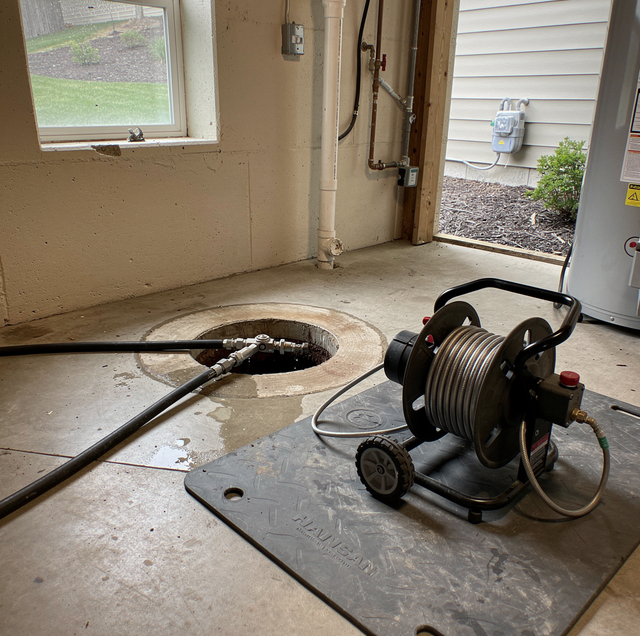
A technician kneels at the cleanout with two tools laid out on a mat: a coiled steel cable on a spinning reel and a hose about as thick as a garden hose, connected to a tank of water held under high pressure. Both tools can open a blocked pipe within the hour. They do not get there the same way, and they do not leave the pipe in the same shape once the job is finished. Choosing between them is not about which tool is better overall. It is about what is actually stuck in the line and what the pipe wall looks like once the water is moving again.
How A Drain Snake Physically Clears A Blockage
A drain snake, sometimes called an auger, works by feeding a rotating or rigid steel cable down the pipe until the tip meets resistance. On a motorized unit, a small drive spins the cable while the operator feeds it forward; a hand-crank auger does the same job with muscle instead of a motor. Once the head reaches the blockage, it either grinds through soft material or hooks onto something solid and pulls it back, clearing a path for water to pass.
That path is the operative detail. A cable head is narrow relative to the pipe it is moving through, so it tends to bore a channel straight through the center of whatever is blocking the line rather than clearing the full width of the pipe. For a single, localized obstruction, that is exactly what is needed: a wad of hair caught in a P-trap, a child's toy lodged in a toilet, a wipe balled up at a fitting, or a mat of roots that has grown in through one cracked joint. The cable reaches the object, breaks it loose or pulls it out, and flow returns almost immediately.
How Hydro Jetting Physically Clears A Pipe
A hydro jetter works on an entirely different principle. Instead of a solid cable, it feeds a flexible hose down the line with a specialized nozzle at the end, and pumps water through that nozzle at pressures typically ranging from around 1,500 to 4,000 pounds per square inch, depending on the pipe size and the nozzle chosen. Rear-facing jets on the nozzle push the hose forward through the pipe while spraying water backward against the direction of travel, and forward-facing jets, when present, cut directly into whatever is blocking the path ahead.
The result is closer to pressure-washing the inside of a pipe than boring through it. As the nozzle travels along the line, the angled jets scour material from the entire inside diameter, not just a channel in the middle. Grease film, soap scum, mineral scale, and the sludge that builds up along the bottom of a horizontal run are stripped from the pipe wall as the hose passes and flushed out ahead of the nozzle toward the cleanout or the main.
What Each Tool Is Actually Good At
The difference between a channel and a full scrub explains why the two tools solve different problems well. Snaking is fast and effective for a single object or a compact mass sitting in one spot: it is the right tool when a line stopped working today because of one specific thing, and that thing needs to be located and removed or broken up. It requires less setup, works on lines a jetter cannot easily reach with the right nozzle, and gets a stopped fixture draining again within minutes.
Jetting earns its keep on a different kind of problem: buildup that has coated a run of pipe over months or years rather than a single event blocking it today. A kitchen line carrying grease down the drain repeatedly develops a film that thickens with every use, and a cable punched through that film just bores a new channel through material that is still coating the walls. The same is true of a sewer lateral coated with years of scale and sludge, or a branch line narrowed by soap residue bound to hard water minerals. A cable can reopen that line for a while. Only a full-diameter scrub actually removes the coating causing the narrowing in the first place.
Hydro Jetting Vs Drain Snaking At A Glance
| Feature | Drain Snaking | Hydro Jetting |
|---|---|---|
| Mechanism | A rotating or rigid steel cable bores through a blockage | Pressurized water jets cut through and scrub the full pipe interior |
| Best suited clog type | A single, localized obstruction: hair, a foreign object, or a root mass at one joint | Buildup coating a run of pipe: grease film, soap scum, mineral scale, sludge |
| Pipe wall cleaning depth | Opens a channel through the material and leaves the surrounding coating in place | Strips material from the full inside diameter, wall to wall, for the length treated |
| When combined use makes sense | First pass to reopen a fully blocked line quickly | Follow-up pass to clean the walls once flow is restored, especially ahead of a camera inspection |
When Snaking Is The Better First Move
A cable is usually the right call when a line is completely stopped, and someone needs water moving again right away. If a bathtub or floor drain has gone from slow to fully blocked in a short span, the most likely cause is a discrete object or mass rather than gradual buildup, and a cable can find and clear that spot in one pass. Snaking is also the more practical choice on a line with tight bends, a smaller diameter, or fixtures where a jetting hose is awkward to run, since a cable can flex through geometry a hose and nozzle assembly may not manage as easily.
Root intrusion at a single cracked joint is another case where a cable does useful work on its own. Cutting the root mass back restores flow, and while the crack itself is a separate structural question, clearing the immediate blockage with a cable buys time to plan the actual repair without leaving a household without a working line in the meantime.
When Jetting Is The Better Choice
Jetting is the stronger option any time buildup, rather than a single obstruction, is the reason a line keeps narrowing. A kitchen line that backs up every few months despite repeated cabling is a good candidate, since the recurring pattern points to a coating problem a cable was never going to solve. The same logic applies to a sewer lateral with years of grease and sludge along the bottom, or a home on well-established plumbing where mineral scale has been binding with soap residue inside branch lines for a long time.
Jetting is also the preferred method before a camera inspection because a clean pipe wall shows a technician exactly what the pipe looks like, rather than a coating that could hide a crack, a belly, or a section of root intrusion underneath. A pipe that has just been jetted gives a camera an accurate read of the material's actual condition, not just whether water is currently flowing through it.
One caution applies here: pipe condition matters before a jetter goes to work. A technician typically checks the line, often with a camera, before choosing pressure and nozzle settings, since older or already-compromised pipe, particularly aging clay, cast iron with weak joints, or bell-and-spigot connections, can react differently to sustained water pressure than newer PVC. Matching pressure and nozzle to the pipe material and condition is part of doing the job correctly, not an afterthought.
Why Plumbers Often Use Both Methods Together
In practice, the two tools frequently show up on the same job rather than as competing choices. When a line is fully blocked, a cable is often run first simply to reopen flow, since getting water moving again does not require the setup a jetter needs and there is no reason to make a household wait. Once flow is restored, a jetter can follow to clean the full diameter of the pipe, removing the buildup a cable's narrow channel left behind and giving the line a fully clear interior rather than one that only looks clear because water is passing through it again.
That sequence also sets up a more useful camera inspection. Running a camera through a pipe still lined with grease or scale shows a technician a coated pipe, not the pipe itself. Jetting first, then running the camera, gives a clear picture of joints, cracks, bellies, and root entry points that a coated line would have hidden. For a line with a history of repeat problems, that combination- cable to reopen it, jetting to clean it, camera to confirm what condition it is actually in- tends to produce a more complete picture than any single step on its own.
The choice between the two tools, in the end, comes down to what is actually happening inside the pipe rather than a fixed rule about which method to reach for first. A single object calls for a cable. A pipe wall coated in buildup calls for a jetter. A line with a real history of repeat trouble usually calls for both, in that order, so the crew clearing it can see, not just guess, what condition the pipe is in once the work is done.
Frequently Asked Questions
Residential jetting equipment typically handles lines from about 1.5 inches up through 6-inch mains, with the nozzle swapped to match the diameter. A smaller nozzle concentrates pressure for a tight branch line, while a larger nozzle spreads flow across a wider main so it cleans the full circumference rather than just cutting a path down the middle.
A cable can punch through soft grease and restore flow, but it only bores a channel through the film rather than removing it from the pipe wall. In a kitchen line that repeatedly develops grease buildup, the channel narrows again as more grease coats the sides, which is why kitchen lines with a recurring pattern are usually better served by jetting.
It can, if pressure and nozzle choice are not matched to the pipe's actual condition. Aging clay pipe, cast iron with corroded joints, and older bell-and-spigot connections can be more vulnerable to sustained high pressure than newer PVC. That is why a technician typically runs a camera down the line first and adjusts settings based on the pipe's actual condition before jetting begins.
It is a jetting nozzle fitted with small rotating blades or an abrasive cutting head designed to shred root intrusion as the nozzle passes through, rather than relying on water pressure alone. It is swapped in when a camera inspection shows that roots have grown into a line, and it is typically followed by a standard flushing nozzle to clear the cut material from the pipe.
A camera shows what is actually inside the line: a single object sitting in one spot, a mat of roots at a joint, or a buildup coating running the length of the pipe. That distinction determines whether a cable alone will solve the problem, whether jetting is needed to remove buildup, or whether both steps make sense in sequence. Choosing a method without that information usually means guessing at what is causing the blockage.
Yes. A rigid cable is a solid steel rod pushed by hand or a small motor, typically used for shorter, more accessible runs, such as a single fixture drain. A cable-based drain machine feeds a longer, more flexible coiled cable from a reel and is built for longer branch lines and sewer laterals where a rigid rod would not reach far enough or flex around the bends.
Schedule a drain evaluation — a technician can inspect your line and recommend snaking, hydro jetting, or both based on what's actually blocking it. Flow Tech Plumbing serves Peoria and the Valley. ROC #347159. Call (623) 267-2703.
