
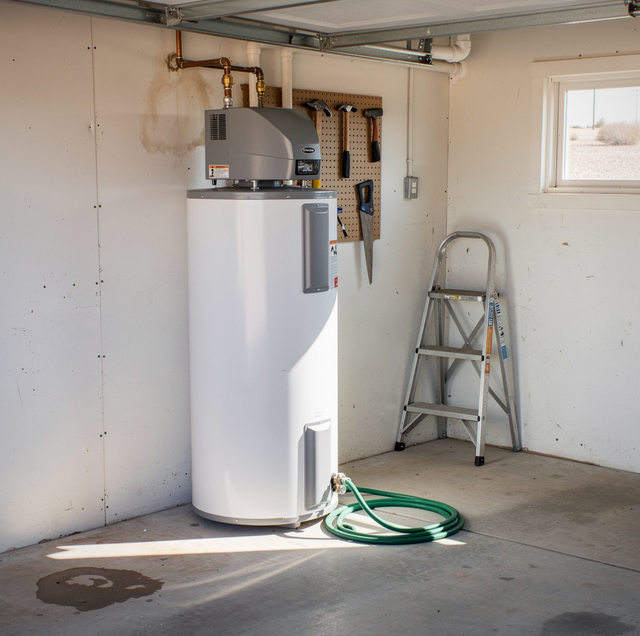
A heat pump water heater and a tankless water heater are compared because both are efficiency-minded alternatives to a standard storage tank. Yet, they achieve that goal by opposite routes. A heat pump unit is still a storage tank: a compressor pulls heat out of the air around it and moves that heat into the water. A tankless heater keeps no stored water at all and fires a gas burner or switches on electric elements only while water flows through it. Because the two work so differently, the right pick comes down to three things: the space the heater goes into, the fuel and power already available at that spot, and how your household draws hot water throughout the day.
The Two Heaters Side by Side
A heat pump unit and a tankless unit compare on heating method, placement, installation needs, long draws, effects on the room, and routine upkeep.
| Factor | Heat Pump Water Heater | Tankless Water Heater |
|---|---|---|
| How the water is heated | A compressor moves heat from room air into a storage tank | A gas burner or electric elements heat water only while it flows through a heat exchanger |
| Where it can go | A space with enough open air around it, and room air warm enough for the compressor to work | A wall with a vent route and a gas supply, or a heavy electric supply for electric models |
| What the install needs | A condensate drain and a dedicated electrical circuit | A gas line and vent, or added electrical capacity; a dedicated circuit where electric |
| A long run of showers | Stored hot water covers the start, then the tank recovers | Continuous output, capped by how much flowing water it can heat at once |
| Effects on the room | Cools and dries the surrounding air; the compressor and fan make audible sound | Takes wall space; its vent path has to stay clear |
| Routine upkeep | Cleaning the air filter on models that have one; keeping the condensate line clear | Descaling the heat exchanger; cleaning the inlet screen |
How a Heat Pump Water Heater Moves Heat
The top of a heat pump water heater holds a small refrigeration circuit. A fan pulls room air across a cold evaporator coil, where the refrigerant absorbs heat from the air and turns into vapor. The compressor compresses the vapor, raising its temperature above that of the water in the tank, and the hot refrigerant then releases its heat through a condenser coil that wraps around the tank or sits inside it. An expansion valve drops the refrigerant to low pressure, then it returns to the evaporator to absorb more heat.
Electricity powers the compressor and the fan; the heat itself comes from the air. Because the evaporator coil is colder than the room, moisture in the passing air condenses on it and drips into a pan, and that water needs a path out of the unit. The unit also carries backup electric elements that take over in some operating modes or when conditions, such as room air being too cool for the compressor, call for them.
Beneath the heat pump assembly sits an ordinary storage tank, and the water it stores gives up some heat to the room between draws, which the compressor then replaces. The compressor adds heat gradually, so the stored volume is what carries the household through a busy stretch.
How a Tankless Unit Heats on Demand
A tankless heater sits idle until a hot tap opens. Water moving through the unit trips a flow sensor; the control board lights the gas burner or powers the electric elements, and the water picks up heat as it passes through the heat exchanger toward the open tap. Nothing is kept hot between uses, so no stored water sits losing heat to the room, and that is where a tankless heater saves energy.
On gas models, the burner modulates, turning up or down to hold the set temperature as the flow through the unit changes. The trade-off is a ceiling on output: a tankless unit can only add so much heat to the water passing through it at one time, so the number of fixtures running together sets its limit.
Where Each One Fits in a House
A heat pump unit needs air around it. The compressor can only move heat that is present in the space, so the unit needs a room with enough open air to draw from and air that stays within the compressor's operating range. A roomy garage or utility room can supply that. A small closet with a solid door can starve it, because the unit keeps pulling heat from the same trapped air until that air is too cool to give up more. The heat pump also needs a place for its condensate to go and clearance for service, and it stands on the floor as a tank does. On some models, the heat pump assembly on top makes the unit taller than a standard tank, so ceiling height at the spot matters.
A tankless unit hangs on a wall and frees up the floor, but it comes with its own requirements. A gas model needs a vent route from its location to the outdoors and a gas line brought to the spot, and an electric model needs its heavy electrical supply run to wherever it mounts. Either kind can sit in a garage, a utility room, or a closet when those routes can be made.
Boxes, bikes and laundry piled near a water heater cause trouble for both types. They can block a gas tankless unit's vent path and combustion air, and they crowd the room air a heat pump unit pulls across its coil.
Fuel and Power at the Install Spot
What is already at the install spot shapes which of the two is simple to put in and which one means new work. A house with a gas line and an existing vent path leans toward a gas tankless unit, because the fuel is already there, though the line and the vent still have to suit the tankless model rather than the tank it replaces. A home without gas service leans the other way. A heat pump water heater runs on electricity alone, so an electric-only home can install one without adding a fuel supply. Because it burns nothing, it produces no combustion gases that need venting.
An electric tankless unit is the other electric-only route, but heating flowing water on the spot draws heavy current, and that supply has to come from the home's electrical service. Before either type goes in, a plumber checks the gas line's capacity for a gas tankless model and the electrical service for an electric tankless or heat pump unit. That check is what separates a swap at the existing connections from a job that brings new pipe, a new vent or added electrical capacity.
Gas connections, venting and the electrical supply are work for licensed trades rather than homeowner projects. Whether the installation needs a permit and inspection is decided by the local authority.
A gas odor around a water heater or its supply line signals a leak that could ignite with a spark. The household leaves the house and calls the gas utility from outside, and a licensed plumber handles any repair to the gas connections.
Hard Water and Upkeep
In a tankless unit, the narrow passages of the heat exchanger are where the water gets hottest, and hard water leaves scale there. Scale insulates the exchanger and narrows its passages, and a unit carrying it can respond with reduced output or an error code on its display. Descaling by a plumber, with the unit isolated at its service valves and a cleaning solution circulated through the heat exchanger, dissolves the scale, and the inlet screen that catches debris at the cold connection also needs cleaning.
A heat pump unit stores its water, so minerals settle as sediment at the bottom of its tank as they do in any storage heater, and an anode rod protects the tank lining. Its own additions to the upkeep list are the air filter over the intake on models that have one, which needs cleaning so the fan can move air across the coil, and the condensate line, which has to keep draining. A clogged condensate line can cause water to back up and pool around the unit, where it can reach wiring and electrical components.
Both types deliver water hot enough to scald at the tap, and the temperature setting on either one is set by the installer to suit the household.
Space, Supply and Draw Pattern, in Order
Three questions settle the choice, taken in order.
The space: A roomy garage or utility room with a drain nearby fits a heat pump unit well. When the only available spot is a tight closet or a bare wall, a tankless unit has the physical advantage.
The fuel and power: A home with gas at the spot and a workable vent path suits a gas tankless unit. An electric-only home suits a heat pump unit, with an electric tankless unit possible where the electrical service can carry its load.
The draw pattern: A household that runs showers back-to-back for a long stretch gets steady output from a tankless unit sized for the fixtures it serves at once, since it keeps heating as long as the flow stays within its limit. A household whose hot water use comes in separate draws spread throughout the day suits a heat pump unit, whose stored volume covers each draw and whose compressor rebuilds the heat in between draws.
When the answers conflict, for example a gas-piped house whose best install spot is a spacious garage, the deciding factor becomes how much new work each option brings at the connections. The plumber's check on the gas line, the vent route and the electrical service is what settles that.
Frequently Asked Questions
It can on models built for it. Some heat pump units accept ducting that draws intake air from another space and sends the cooled exhaust air elsewhere, which lets a closet install work without starving the compressor. Without ducting, the closet has to open onto a larger space so the unit's air supply keeps refreshing.
A condensing model does. It pulls additional heat from its exhaust through a second heat exchanger, cooling the exhaust enough for water to condense inside the unit. The condensate is acidic, and a neutralizer in its drain line can protect the drain it empties into. Non-condensing gas models and electric tankless units form no condensate inside the heater.
Its drain line runs by gravity to a floor drain, a laundry standpipe, or a similar receptor when one sits lower than the unit's drain fitting. Where no drain sits low enough, a small condensate pump collects the water and pushes it up and across to a drain.
No. The water already sitting in the pipe between the heater and the fixture has to run out first, and the unit needs a moment to sense flow and fire. Turning a tap off and back on quickly can also send a short slug of cool water between two hot ones while the unit restarts. A recirculation setup, when available, keeps hot water close to the fixtures.
Mode names differ between brands, but the settings can include a heat-pump-only mode that runs the compressor alone, a hybrid mode that leads with the compressor and calls on the elements during heavy demand, an electric or high-demand mode that runs the elements, and a vacation mode that holds the tank at a low temperature while the house sits empty.
Outdoor-rated models can. They mount on an exterior wall and exhaust straight from their cabinet, so no vent pipe has to run through the house. They still need the gas line brought to them and an electrical connection for their controls, and the wall they hang on has to keep that exhaust clear of windows and doors.
Hire a plumber for water heater installation, heat pump or tankless — an assessment of the install spot, the gas line or electrical capacity, and the venting, with the unit matched to how your household draws hot water. Flow Tech Plumbing serves Peoria and the Valley. ROC #347159. Call (623) 267-2703.