
Every fixture drain needs a source of air, and it gets that air in one of two ways. A pipe can rise from the drain line and leave the house through the roof, open to outdoor air at all times, or a mechanical valve can sit on a short pipe near the fixture and open only while water is draining. Both keep trap seals in place during ordinary use, so the useful question is what each one can and cannot do. Setting each factor beside the valve and the open vent shows where the two part ways:
| Factor | Air admittance valve | Open vent through the roof |
|---|---|---|
| Which way air moves | Inward only, from the room around it | Both ways, to and from outdoor air |
| Relieves pressure pushing back up the pipe | No; it stays shut when drain pressure rises | Yes; the pressure has an open exit |
| Moving parts | A sealing diaphragm or disc inside a housing | None |
| Where it sits | Indoors, near the fixture it serves | Through the roof, above the roofline |
| Access it needs | Open space and room air around it | A clear terminal and a sound roof seal |
| What failure looks like | Sewer odor at the cabinet or wall opening | Gurgling or slow drains on the fixtures it serves |
| Whether it is accepted | The local inspector decides | The local inspector decides |
What the Valve Does While a Drain Runs
Water leaving a sink or tub pulls air along behind it, and a drain that cannot replace that air starts drawing it from the nearest trap. The question is where that replacement air comes from.
An air admittance valve answers that question with room air. The housing threads or glues onto a pipe that rises from the drain line past the trap. While the fixture is idle, the pressure inside the drain matches the pressure in the room, and the valve stays sealed, so no sewer gas can leave through it. When water starts moving, and the pressure inside the pipe drops below room pressure, the diaphragm lifts and air from the cabinet or wall space flows in to fill the gap. The trap seal stays where it belongs because the drain found an easier source of air.
That is the whole job. Air goes in, and nothing comes out. The valve does not move gas, water, or pressure in the other direction, and it does not need to for the fixture it serves to drain cleanly. A pipe open to the roof does the same inward job without a moving part, and it also does the outward job, which is where the comparison turns.
Why the System Still Needs One Vent Open to the Air
A drain system does not only go negative. Water dropping down a stack pushes air ahead of it, and that air has to leave somewhere. An open vent gives it an exit through the roof. A valve does the opposite of what the moment needs: rising pressure holds it shut, so the air looks for the next weakest point, such as a trap seal it can push through into a room.
The second job is gas release. Wastewater in the building drain and the sewer beyond it emits hydrogen sulfide, methane, and other gases, which collect in the pipe whether or not anything is draining. An open vent lets them rise and leave above the roofline, where they disperse. A working valve lets nothing out, so a system built with no open vent at all would have gas and pressure sealed inside with nowhere to go except through a fixture.
That is why a sound design keeps at least one pipe open to outdoor air and adds valves only as helpers on branches. It also explains why a roof vent opening is never sealed or capped to prevent odor. Capping it removes the exit the whole system depends on, and the smell it was meant to stop comes back through the traps instead.
Placement Above the Trap and the Drain It Vents
A valve depends on sitting clear of the water in the drain it serves. It connects to the sewer side of the trap, and its opening rises above the trap and the horizontal drain it vents to, so ordinary flow never reaches it.
Set too low, ordinary draining can reach it: a surge or a partial backup in the branch climbs the vent pipe and washes wastewater and debris over the seal and the seat it closes against. Nothing about that event shows. The water recedes, the sink drains again, and the valve looks untouched from the outside. What changes is whether the seal still closes tight, and the first sign can be a sewer smell inside a closed cabinet later on, with no clog, no leak, and no obvious reason.
A smell at a fixture can also come from a dried-out trap, so odor alone does not convict the valve. Where the valve sits and whether it sits high enough are the first things to check before blaming the seal itself.
Keeping the Valve Reachable
A roof vent pipe can be closed up inside a wall because it has no moving part to service. A valve is the reverse. It has to stay where a person can see it, reach it, and take it off its fitting, and it needs a supply of room air, because room air is the only air it can admit.
Under a sink cabinet, both conditions come for free. Inside a finished wall or a closed soffit, neither does. A valve sealed behind drywall has no air to draw on, so it cannot open fully when the drain needs it, and a failed seal there leaks sewer gas into a cavity where nobody will notice it until the smell reaches a room.
A valve set inside a wall sits behind a louvered grille. The slots allow room air to reach the valve and let someone see the fitting and catch an odor at the source.
Reachability also governs the check itself. A plumber confirming that a valve still seals needs to see it, remove it from its fitting, and inspect the seat. When a remodel buries a valve behind finished tile or cabinetry with no opening, every later question about that fixture's venting starts with demolition.
Where a Valve Fits and Where It Does Not
The strongest case for a valve is a fixture that is far from any existing vent and hard to connect to one. An island sink is a plain example: there is no wall to run a pipe up to the attic, so the options are a valve under the counter or an open pipe run below the floor. The second is a remodel that moves a vanity or a kitchen sink to a new wall, well away from the stack. Running a new vent there can mean opening finished ceilings and walls, crossing framing, and cutting a new hole through the roof, while a valve can sit in the vanity or sink base.
The weakest cases are the ones where a valve cannot do its one job or where its limits start to matter:
As the only vent in the house: a building with no open vent has no route for pressure or gas to leave, so the valve becomes the reason traps get pushed out.
On a sealed sewage basin or ejector pit: a pumped basin pushes air out as it fills and pulls air in as the pump empties it, so it needs a vent that moves air both ways.
Where it cannot sit above the trap: if the layout forces the valve below the trap or below the drain it vents, the valve is set up for the silent fouling a surge leaves on its seal.
Where no one can reach it: a valve buried in a closed wall or ceiling fails where it cannot be seen.
Acceptance varies. Whether a valve is allowed on a given fixture, in a given building, is decided by the local inspector for that project, and a plan that works in one place may not pass in another.
How a Plumber Decides on a Remodel
The decision starts with the map of what is already there. A plumber locates the main stack and any branch vents near the new fixture location and asks whether a new vent pipe can reach one of them without cutting through finished surfaces the project is not already opening. When walls and ceilings are open anyway, an open vent can be added while they are open, and the valve question goes away.
When they are not open, the next test is whether a valve can sit where it works: above the trap and the drain it vents, upright, reachable, and in a space with room air around it. A vanity or a sink base passes that test. A fixture tucked under a stair, or one draining through a pump, may not.
The last test is the building as a whole. Adding valves assumes the house still has its open vent, so a plumber confirms that the main stack runs through the roof and is clear before adding a helper on a branch. The local inspector's view closes the decision, and the plan is built to what that office will accept.
Throughout the project, any sewer-gas smell is treated as a signal to find its source, not as something to cover with a deodorizer or a fan.
A drain or vent pipe opened inside a wall can release hydrogen sulfide and spill standing wastewater onto whoever makes the cut. A plumber isolates the line and ventilates the space before opening it, which keeps that job off a homeowner's list.
Frequently Asked Questions
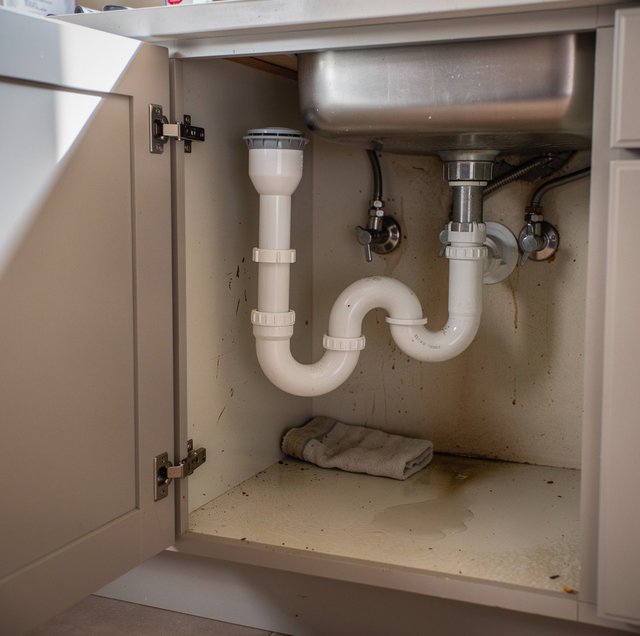
Open the cabinet under the sink and look past the trap. A valve is a plastic fitting sitting on a short upright pipe that rises from the drain line, with a slotted or ribbed cap on top. Some thread onto an adapter so they can be unscrewed by hand.
Yes. "Cheater vent" is trade slang for the same one-way valve, and "mechanical vent" is another name for it. A bare pipe stub left open under a cabinet is something else entirely: it is an open path for sewer gas into the room, not a vent of any kind.
Yes. A loop vent, sometimes called an island fixture vent, rises from the drain as high as the cabinet allows, bends back down, and ties into a vent line below the floor. It is an open pipe with no moving parts, but it requires floor access for construction and the inspector's approval.
It does. Valves are rated by the drainage fixture units they can serve, a measure of the drain load flowing past them. A model rated for a single branch is a different product from one rated to vent a stack, and a valve undersized for its load can starve the drain of air.
A smoke test is one method. Nontoxic smoke is pushed into the drain system through a cleanout, and it should appear only at the roof terminals. Smoke that appears indoors, around a valve, a fitting, or a fixture base, marks a seal that leaks.
Beyond an opening kept clear, the part that wears is the flashing boot around the pipe. That boot's rubber collar weathers on the roof and can crack, letting rain run down the outside of the vent pipe into the attic or a ceiling below it. A cracked collar calls for roof repair.
Enlist a plumber for bathroom or kitchen venting — vent routing on a remodel, island sink venting and valve placement above the trap and the drain it vents. Flow Tech Plumbing serves Peoria and the Valley. ROC #347159. Call (623) 267-2703.